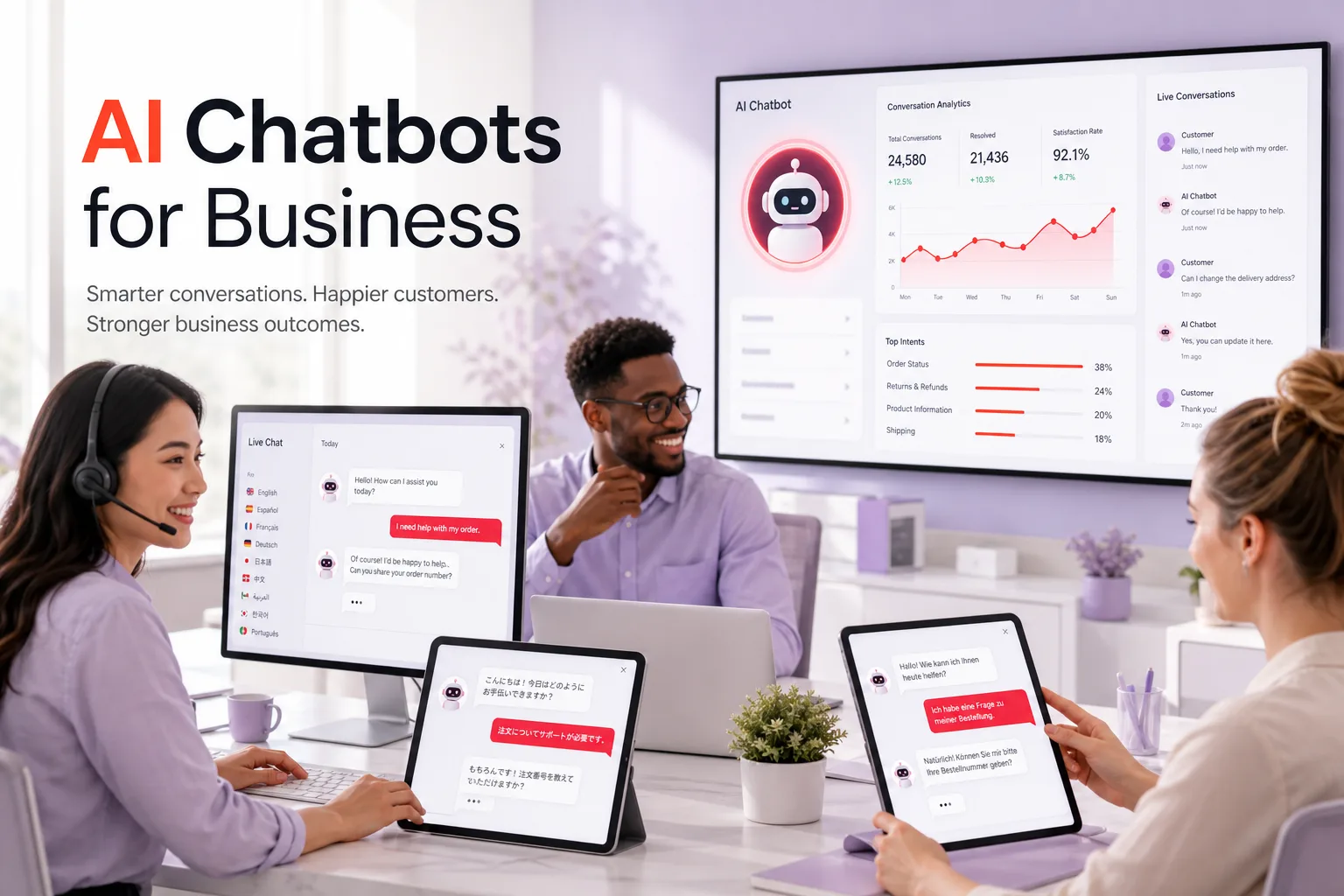
Customer expectations have changed dramatically in recent years. People expect businesses to respond quickly, provide accurate information, and offer support whenever they need it. Meeting these expectations with human agents alone can be expensive and difficult to scale.
AI chatbots help solve this challenge by providing instant, intelligent conversations across websites, mobile apps, messaging platforms, and customer portals. Modern AI chatbots can answer questions, qualify leads, automate repetitive tasks, and support customers around the clock.
Businesses of every size are adopting AI chatbots to improve customer experiences while reducing operational costs.
In this guide, we'll explore how AI chatbots work, their business benefits, common use cases, and best practices for successful implementation.
What Is an AI Chatbot?
An AI chatbot is a software application that uses artificial intelligence to understand questions, interpret user intent, and generate natural responses.
Unlike traditional rule-based chatbots that only respond to predefined commands, AI chatbots can:
- Understand natural language
- Maintain conversations
- Answer complex questions
- Learn from interactions
- Access business information
- Perform automated tasks
- Escalate conversations to human agents when needed
This creates a more helpful and natural user experience.
If you're evaluating AI more broadly, our guide on how AI is transforming modern businesses in 2026 explains where chatbots fit within a larger AI strategy.
How AI Chatbots Work
Modern AI chatbots combine several technologies.
These may include:
- Natural Language Processing (NLP)
- Large Language Models (LLMs)
- Machine Learning
- Knowledge Bases
- API Integrations
- Workflow Automation
Together, these technologies allow chatbots to understand user requests, retrieve relevant information, and provide useful responses in real time.
Benefits of AI Chatbots
24/7 Customer Support
Customers expect assistance outside traditional business hours.
AI chatbots provide immediate responses at any time of day, helping businesses serve customers without increasing staffing costs.
Faster Response Times
Waiting for email replies or support agents can frustrate customers.
AI chatbots respond instantly to common questions about:
- Products
- Services
- Pricing
- Orders
- Appointments
- Shipping
- Returns
Quick responses improve customer satisfaction.
Lower Support Costs
Many customer inquiries are repetitive.
AI chatbots automate routine conversations, allowing support teams to focus on complex requests that require human expertise.
This can reduce operational costs while improving efficiency. For broader automation strategy, see our guide to AI automation for businesses.
Lead Generation
Chatbots can engage website visitors and collect valuable information.
Examples include:
- Contact details
- Business requirements
- Budget information
- Preferred services
- Appointment requests
Qualified leads can then be routed directly to the sales team.
Personalized Customer Experiences
AI chatbots can provide recommendations based on:
- Purchase history
- Browsing behavior
- Customer preferences
- Previous conversations
- Account information
Personalized interactions improve engagement and conversion rates.
Common Business Use Cases
Customer Support
Businesses use AI chatbots to:
- Answer frequently asked questions
- Resolve common issues
- Track orders
- Provide account information
- Schedule support appointments
Sales Assistance
Sales chatbots help customers by:
- Recommending products
- Comparing options
- Answering pricing questions
- Scheduling demonstrations
- Collecting sales inquiries
Appointment Booking
Healthcare providers, consultants, and service businesses use chatbots to:
- Schedule appointments
- Confirm bookings
- Send reminders
- Handle cancellations
- Answer availability questions
Employee Support
Internal AI assistants help employees access company information.
Examples include:
- HR policies
- IT support
- Leave requests
- Training materials
- Internal documentation
eCommerce
Retail businesses use AI chatbots for:
- Product recommendations
- Cart recovery
- Order tracking
- Return requests
- Payment assistance
- Customer feedback
For a WooCommerce-specific implementation guide, see How to Add an AI Chatbot to a WooCommerce Store.
Industries Using AI Chatbots
AI chatbots provide value across many industries.
Examples include:
- Healthcare
- Retail
- Financial services
- Real estate
- Education
- Hospitality
- Manufacturing
- Logistics
- Professional services
- SaaS companies
Every industry can benefit from faster communication and workflow automation.
Essential Features of an AI Chatbot
When planning an AI chatbot, businesses should consider features such as:
- Natural language understanding
- Multi-language support
- Context-aware conversations
- CRM integration
- Live agent handoff
- Knowledge base integration
- Analytics dashboard
- Conversation history
- Workflow automation
- Omnichannel support
The right features depend on your business goals and customer needs.
Businesses adding chatbots to mobile products should also review AI features every modern mobile app should include when planning the full user experience.
Integrating AI Chatbots With Business Systems
AI chatbots become more powerful when connected to existing software.
Common integrations include:
- CRM systems
- ERP platforms
- Help desk software
- Booking systems
- Payment gateways
- Email marketing platforms
- Inventory management systems
- Mobile applications
These integrations allow chatbots to complete actions rather than simply answering questions.
Reliable API development and integration is often essential when chatbots need to access live business data, update records, or trigger workflows across multiple platforms.
Best Practices for Successful Chatbots
To maximize business value:
Define Clear Objectives
Decide whether the chatbot should focus on support, sales, appointments, internal productivity, or multiple use cases.
Train With Business Data
A chatbot performs better when it has access to accurate and up-to-date business information.
Keep Human Support Available
Provide an option to transfer complex conversations to a human representative.
Monitor Performance
Track metrics such as:
- Response accuracy
- Customer satisfaction
- Resolution rate
- Lead generation
- Conversation completion
Continuous improvement helps the chatbot become more effective over time.
Common Challenges
Businesses should prepare for challenges such as:
- Poor training data
- Integration complexity
- Privacy requirements
- User adoption
- Maintaining knowledge accuracy
Planning for these factors helps ensure a successful implementation.
Custom chatbot projects often overlap with custom AI software development when businesses need tailored workflows, proprietary data access, or deep system integration.
How Kodu Media Builds AI Chatbot Solutions
At Kodu Media, we develop AI chatbot solutions that improve customer experiences and business efficiency.
Our services include:
- AI chatbot strategy
- Custom chatbot development
- Website chatbot integration
- Mobile app chatbot integration
- CRM integration
- Workflow automation
- Knowledge base development
- API integration
- Analytics implementation
- Ongoing optimization and support
We focus on building chatbots that solve real business challenges and deliver measurable results.
Explore our dedicated AI chatbots and virtual assistants service page, or learn how our broader AI automation services and AI development company teams support end-to-end implementation.
We also integrate chatbots into mobile app development, SaaS development, and custom software development projects when conversational AI is part of a larger digital product.
Thoughtful UI/UX design helps ensure chatbot interactions feel natural, trustworthy, and easy to use across web and mobile channels.
Final Thoughts
AI chatbots have evolved far beyond simple automated responses. Today's intelligent assistants help businesses improve customer support, generate leads, automate repetitive tasks, and provide personalized experiences across multiple channels.
Whether you're supporting customers, assisting employees, or improving sales processes, an AI chatbot can become a valuable part of your digital strategy.
The most successful chatbot implementations begin with clear business objectives, high-quality data, and thoughtful integration with existing systems.
If you're considering an AI chatbot for your business, Kodu Media can help you design, develop, and integrate a solution tailored to your goals.
Contact us today for a free consultation and discover how AI chatbots can improve your customer experience and operational efficiency.
Frequently Asked Questions
What is the difference between an AI chatbot and a traditional chatbot?
Traditional chatbots follow predefined rules, while AI chatbots use natural language processing and machine learning to understand conversations and provide more intelligent responses.
Can AI chatbots integrate with CRM systems?
Yes. AI chatbots can connect with CRM platforms, booking systems, help desk software, payment gateways, and many other business applications.
Can an AI chatbot replace human support agents?
AI chatbots handle repetitive questions efficiently, but complex issues often require human assistance. The best approach combines AI automation with human support.
How long does it take to build a custom AI chatbot?
The timeline depends on the chatbot's complexity, integrations, training data, and business requirements.
Does Kodu Media develop custom AI chatbots?
Yes. We design and develop AI chatbot solutions for websites, mobile apps, internal business systems, and customer support platforms, with custom integrations and ongoing optimization.