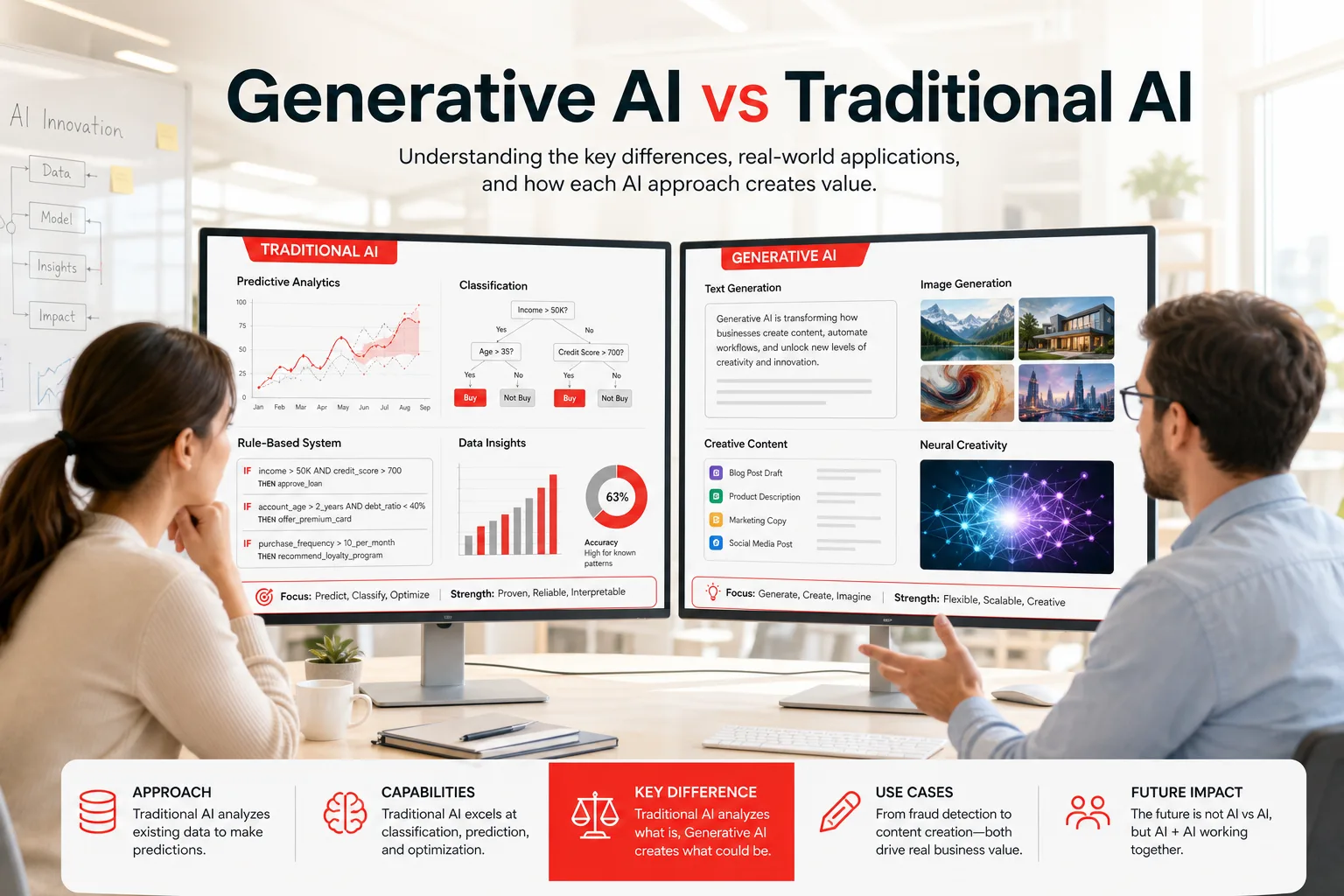
Artificial Intelligence has become a major driver of digital transformation, but not all AI technologies work in the same way. As Generative AI tools become more common, many business leaders are asking how they differ from traditional AI systems and which approach is best suited to their organization.
While both technologies use data and algorithms to solve problems, they serve different purposes. Traditional AI is designed to analyze information, make predictions, and automate decisions. Generative AI goes a step further by creating new content such as text, images, code, audio, and videos.
Understanding these differences helps businesses make better technology decisions and identify the right opportunities for AI adoption.
In this guide, we'll compare Generative AI and Traditional AI, explore their strengths, limitations, and business applications, and explain when each approach makes the most sense.
What Is Traditional AI?
Traditional AI focuses on analyzing existing data to make predictions, classifications, recommendations, or automated decisions.
Rather than creating new content, traditional AI identifies patterns and uses those patterns to solve business problems.
Common capabilities include:
- Predictive analytics
- Fraud detection
- Recommendation engines
- Customer segmentation
- Demand forecasting
- Quality inspection
- Risk analysis
- Process automation
Traditional AI has been used in business for many years across industries such as healthcare, finance, manufacturing, and retail.
If you're evaluating a broader AI strategy, our overview of how AI is transforming modern businesses in 2026 explains how predictive and analytical AI fit into modern operations.
What Is Generative AI?
Generative AI is designed to create new content based on user prompts and training data.
Instead of only analyzing information, it can generate:
- Articles
- Emails
- Product descriptions
- Images
- Source code
- Reports
- Marketing copy
- Business documentation
- Customer responses
Modern Generative AI systems use Large Language Models (LLMs) and other advanced machine learning techniques to understand context and produce natural responses.
Generative AI vs Traditional AI at a Glance
| Feature | Traditional AI | Generative AI |
|---|---|---|
| Primary Purpose | Analyze and predict | Create new content |
| Input | Structured and historical data | Prompts, documents, and datasets |
| Output | Predictions, recommendations, classifications | Text, images, code, audio, and more |
| Learning Focus | Pattern recognition | Content generation and reasoning |
| Business Goal | Automation and decision support | Productivity and content creation |
How Traditional AI Works
Traditional AI systems learn from historical data.
For example:
- An eCommerce platform predicts which products customers may purchase.
- A bank identifies suspicious transactions.
- A manufacturer predicts equipment failures.
- A retailer forecasts inventory demand.
The AI analyzes patterns and produces recommendations or decisions based on historical information.
These use cases often power AI automation for businesses when repetitive decisions and workflows can be standardized.
How Generative AI Works
Generative AI models are trained on large datasets that help them understand language, context, and relationships between concepts.
Users interact with these systems through prompts.
Examples include:
- Write a customer email.
- Summarize a report.
- Generate product descriptions.
- Create software documentation.
- Produce marketing content.
- Answer customer questions.
The system generates new content rather than retrieving existing information.
Business Use Cases for Traditional AI
Traditional AI remains essential for many business operations.
Common applications include:
- Sales forecasting
- Fraud detection
- Credit scoring
- Predictive maintenance
- Inventory optimization
- Customer segmentation
- Recommendation systems
- Business intelligence
These systems help organizations improve efficiency and make better decisions.
Business Use Cases for Generative AI
Generative AI is transforming knowledge work.
Popular use cases include:
- Customer support assistants
- AI chatbots
- Marketing content creation
- Proposal writing
- Software development assistance
- Knowledge management
- Internal documentation
- Meeting summaries
- Product content generation
- Training materials
Businesses use Generative AI to improve productivity and reduce manual work.
Many of these applications overlap with AI chatbots for business when conversational interfaces are part of the solution.
Advantages of Traditional AI
Traditional AI offers several benefits.
These include:
- Proven reliability
- Accurate predictions
- Strong analytical capabilities
- Business process optimization
- Lower operational risk for established use cases
It is particularly effective for organizations working with structured business data.
Advantages of Generative AI
Generative AI introduces new opportunities for innovation.
Benefits include:
- Faster content creation
- Improved employee productivity
- Better customer experiences
- Personalized communication
- Faster software development
- More efficient knowledge sharing
These capabilities help businesses automate creative and communication tasks.
Limitations of Traditional AI
Traditional AI also has limitations.
These may include:
- Dependence on historical data
- Limited creativity
- Less flexibility
- Complex model training
- Difficulty handling unstructured information
Limitations of Generative AI
Businesses should also understand the challenges of Generative AI.
Potential limitations include:
- Inaccurate responses
- Hallucinations
- Data privacy concerns
- Need for human review
- Regulatory considerations
- Model training costs
Organizations should implement governance and quality control when deploying Generative AI solutions.
Can Businesses Use Both?
Yes.
Many organizations combine Traditional AI and Generative AI to create more powerful solutions.
For example:
- Traditional AI predicts customer behavior.
- Generative AI creates personalized marketing emails.
Or:
- Traditional AI detects support issues.
- Generative AI drafts responses for customer service teams.
Combining both technologies often delivers the greatest business value.
This hybrid approach is common in custom AI software development when businesses need tailored solutions rather than one-size-fits-all tools.
Choosing the Right AI Strategy
When evaluating AI, consider:
- Business objectives
- Available data
- Security requirements
- Existing systems
- Budget
- Team capabilities
- Long-term scalability
The right solution depends on the specific problems your business is trying to solve.
How Kodu Media Helps Businesses Implement AI
At Kodu Media, we help organizations identify where AI can deliver measurable business value.
Our services include:
- AI consulting
- Generative AI development
- Custom AI software
- AI chatbot development
- Workflow automation
- Predictive analytics
- API integration
- Mobile and web AI integration
- Ongoing optimization and support
We recommend practical AI solutions based on your business goals rather than following technology trends alone.
Our AI development company team supports both predictive AI systems and Generative AI applications, while our AI automation services help connect intelligent workflows to existing business software.
We also integrate AI into custom software development, mobile app development, and API development and integration projects when AI needs to work across multiple platforms.
Final Thoughts
Generative AI and Traditional AI are not competing technologies. They solve different business problems and often work best together.
Traditional AI excels at prediction, analysis, and automation. Generative AI enhances creativity, communication, and productivity by creating new content and supporting knowledge-based tasks.
Understanding the strengths of each approach allows businesses to invest in AI solutions that deliver measurable value and support long-term growth.
If you're exploring AI for your organization, Kodu Media can help you evaluate your options, develop the right strategy, and implement intelligent solutions tailored to your business.
Contact us today to schedule a consultation and discover how AI can transform your operations.
Frequently Asked Questions
What is the main difference between Generative AI and Traditional AI?
Traditional AI analyzes existing data to make predictions or automate decisions, while Generative AI creates new content such as text, images, code, and reports.
Can Generative AI replace Traditional AI?
No. The two technologies serve different purposes. Many businesses use both together to improve automation and productivity.
Which industries benefit from Generative AI?
Retail, healthcare, finance, education, manufacturing, legal services, marketing, and professional services are using Generative AI to improve efficiency and customer experiences.
Is Generative AI suitable for small businesses?
Yes. Small businesses can use Generative AI for customer support, content creation, marketing, documentation, and workflow automation.
Does Kodu Media develop Generative AI solutions?
Yes. We develop custom Generative AI applications, AI chatbots, workflow automation, intelligent assistants, and AI-powered business software tailored to each client's needs.