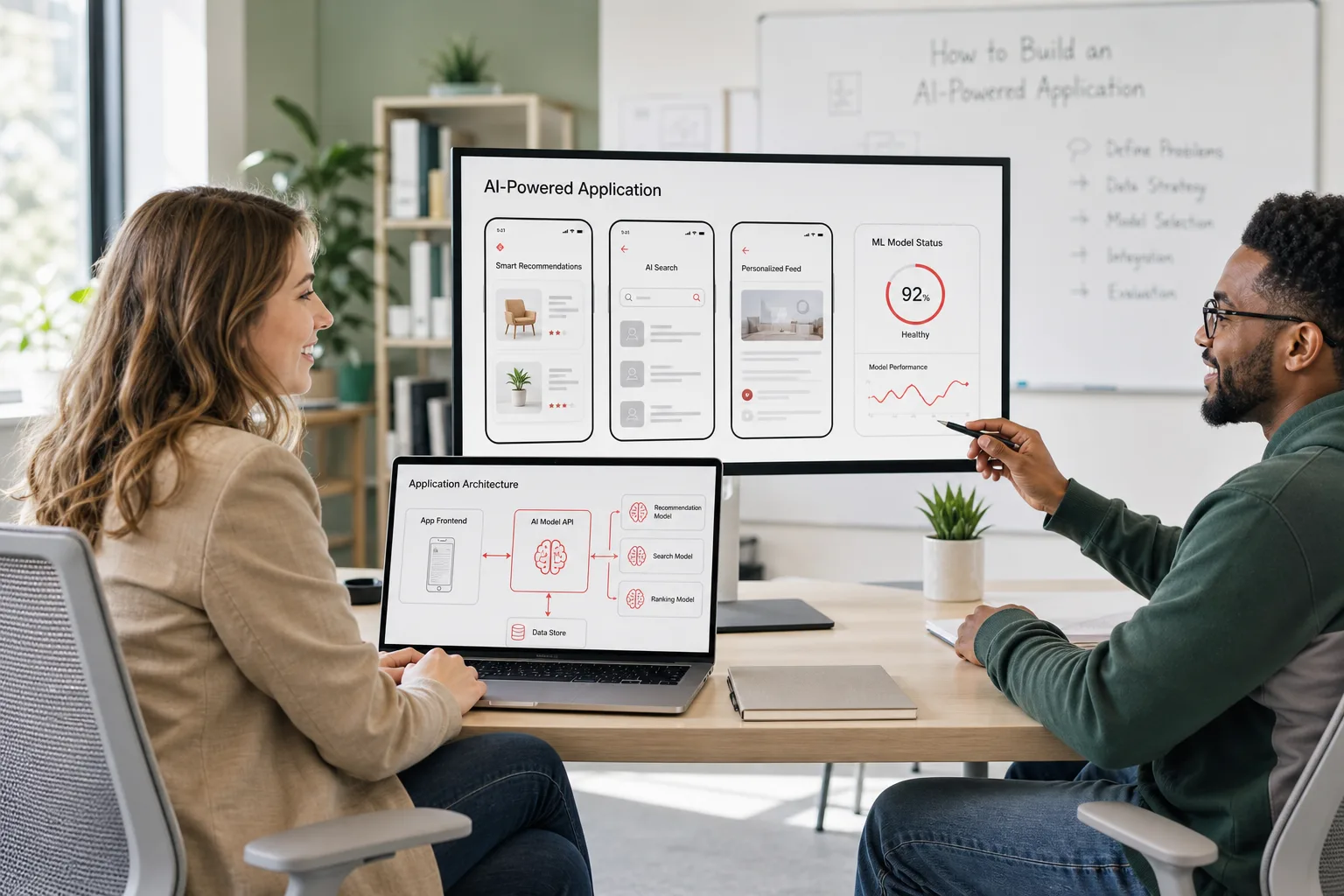
Artificial Intelligence is changing how businesses develop software, automate operations, and deliver personalized customer experiences. From intelligent customer support to predictive analytics and workflow automation, AI-powered applications are helping organizations improve efficiency and create competitive advantages.
Building an AI application involves much more than integrating a language model or chatbot. Success depends on understanding business goals, selecting the right AI technologies, preparing quality data, designing intuitive user experiences, and creating scalable software architecture.
In this guide, we'll explain the complete process of building an AI-powered application and share best practices that help businesses maximize their investment.
What Is an AI-Powered Application?
An AI-powered application combines traditional software with artificial intelligence to perform tasks that normally require human intelligence.
Depending on your business needs, an AI application may:
- Understand natural language
- Generate content
- Analyze documents
- Predict future outcomes
- Recommend products
- Automate workflows
- Answer customer questions
- Detect fraud
- Recognize images
- Process voice commands
The goal is not simply to add AI, but to solve real business problems more efficiently.
If you're still comparing AI approaches, our guide on Generative AI vs Traditional AI explains how different technologies fit different business goals.
Why Businesses Are Investing in AI Applications
Organizations across industries are adopting AI because it creates measurable business value.
Common objectives include:
- Reducing manual work
- Improving customer service
- Increasing productivity
- Automating repetitive processes
- Enhancing decision-making
- Personalizing user experiences
- Lowering operational costs
- Supporting business growth
When implemented strategically, AI can improve both internal operations and customer-facing experiences.
For a broader view of why companies are investing now, read how AI is transforming modern businesses in 2026.
Step 1: Define the Business Problem
Every successful AI project begins with a clearly defined objective.
Ask questions such as:
- What problem are we trying to solve?
- Who will use the application?
- What business outcome do we expect?
- How will success be measured?
Examples include reducing customer support response times, improving sales forecasting, automating document processing, or increasing employee productivity.
A clear objective keeps the project focused and helps prioritize features.
Step 2: Identify AI Opportunities
Not every feature requires artificial intelligence.
Evaluate where AI can create the greatest impact.
Examples include:
- AI chatbots
- Smart search
- Personalized recommendations
- Predictive analytics
- Document summarization
- Image recognition
- Voice assistants
- Automated reporting
Selecting the right use cases helps maximize return on investment.
Our guide to AI features every modern mobile app should include is a useful reference when planning customer-facing product capabilities.
Step 3: Gather and Prepare Data
AI systems rely on high-quality data.
Data may come from:
- CRM systems
- ERP platforms
- Customer support tickets
- Internal documents
- Product catalogs
- Transaction records
- Public datasets
- APIs
Before development begins, data should be reviewed for quality, consistency, security, and compliance.
Poor data often leads to poor AI performance.
Step 4: Choose the Right AI Technology
Different business problems require different AI technologies.
Examples include:
- Large Language Models (LLMs) for conversational AI and content generation
- Machine Learning for predictions and recommendations
- Computer Vision for image and video analysis
- Natural Language Processing for document understanding
- Speech Recognition for voice-enabled applications
The right technology depends on your business goals, available data, and expected outcomes.
An experienced AI development company can help you match technology choices to business outcomes rather than trends alone.
Step 5: Design the User Experience
AI should improve the user experience rather than complicate it.
Design considerations include:
- Simple interfaces
- Clear AI interactions
- Transparent responses
- Human handoff when needed
- Accessibility
- Mobile responsiveness
Users should understand how AI assists them and when human support is available.
Professional UI/UX design is especially important in AI products because trust, clarity, and ease of use directly affect adoption.
Step 6: Build the Application
Development combines traditional software engineering with AI capabilities.
This stage often includes:
- Frontend development
- Backend development
- Database design
- API integration
- Authentication
- AI model integration
- Security implementation
- Cloud infrastructure
The application should be designed to scale as usage increases.
Depending on your product type, this may involve custom software development, mobile app development, or SaaS development alongside AI integration.
Reliable API development and integration is often required when AI features must connect with CRM, ERP, support, payment, or analytics systems.
Step 7: Test the AI System
Testing an AI application requires more than checking whether features work.
Testing should evaluate:
- Accuracy
- Response quality
- Security
- Performance
- Scalability
- User experience
- Edge cases
- Integration reliability
Continuous testing helps improve the quality of AI responses.
Step 8: Deploy and Monitor
Deployment is only the beginning.
After launch, monitor:
- User engagement
- AI accuracy
- System performance
- API usage
- Costs
- Customer feedback
- Business outcomes
Monitoring allows you to identify opportunities for continuous improvement.
Step 9: Improve Over Time
Successful AI applications continue evolving.
Future improvements may include:
- Better prompts
- Additional integrations
- New AI capabilities
- Workflow automation
- Improved analytics
- Expanded language support
Continuous optimization ensures the application remains valuable as business needs change.
Common Challenges in AI Development
Businesses should prepare for challenges such as:
- Poor data quality
- Complex integrations
- AI response accuracy
- Privacy requirements
- Security concerns
- Regulatory compliance
- User adoption
Working with experienced AI developers helps reduce these risks.
For a deeper look at implementation planning, review our guides on custom AI software development and AI automation for businesses.
Best Practices for AI Application Development
Businesses can improve project outcomes by following these recommendations.
Start With One High-Value Use Case
Avoid trying to solve every problem in the first release.
Focus on User Value
AI should simplify work, improve experiences, or save time.
Protect Sensitive Data
Implement strong security, access controls, and compliance measures.
Measure Success
Track metrics such as:
- Productivity improvements
- Customer satisfaction
- Response times
- Cost savings
- User adoption
- Return on investment
These metrics help guide future development.
How Kodu Media Builds AI Applications
At Kodu Media, we help businesses transform AI ideas into practical software solutions.
Our services include:
- AI consulting
- Product discovery
- Custom AI software development
- AI chatbot development
- Mobile and web application development
- API integration
- Cloud deployment
- AI workflow automation
- Testing and quality assurance
- Ongoing optimization and support
Every AI application is designed around your business objectives and built for long-term scalability.
We also deliver specialized solutions through AI automation services and AI chatbots and virtual assistants when conversational AI is part of the product roadmap.
Final Thoughts
Building an AI-powered application is about more than implementing advanced technology. It requires a clear understanding of your business goals, thoughtful planning, quality data, and a scalable development approach.
By focusing on real business challenges and delivering measurable value, AI applications can improve productivity, enhance customer experiences, and create lasting competitive advantages.
Whether you're planning an AI-powered customer portal, internal business platform, intelligent mobile app, or workflow automation solution, partnering with an experienced development team can help reduce risk and accelerate success.
If you're ready to build an AI-powered application, Kodu Media can help you define your strategy, select the right technologies, and develop a solution tailored to your business.
Contact us today to schedule a free consultation and start your AI development journey.
Frequently Asked Questions
What is an AI-powered application?
An AI-powered application combines traditional software with artificial intelligence to automate tasks, analyze data, generate content, or provide intelligent recommendations.
Do I need a large amount of data to build an AI application?
Not always. Some AI solutions use pre-trained models, while others benefit from business-specific data. The data requirements depend on your use case.
How long does it take to build an AI application?
The timeline depends on the project's complexity, required integrations, available data, and testing requirements.
Can AI be added to an existing application?
Yes. Many businesses enhance existing web, mobile, or desktop applications by integrating AI-powered features such as chatbots, search, automation, and predictive analytics.
Does Kodu Media build custom AI applications?
Yes. We develop custom AI-powered web applications, mobile apps, internal business platforms, automation solutions, and intelligent software tailored to each client's business goals.