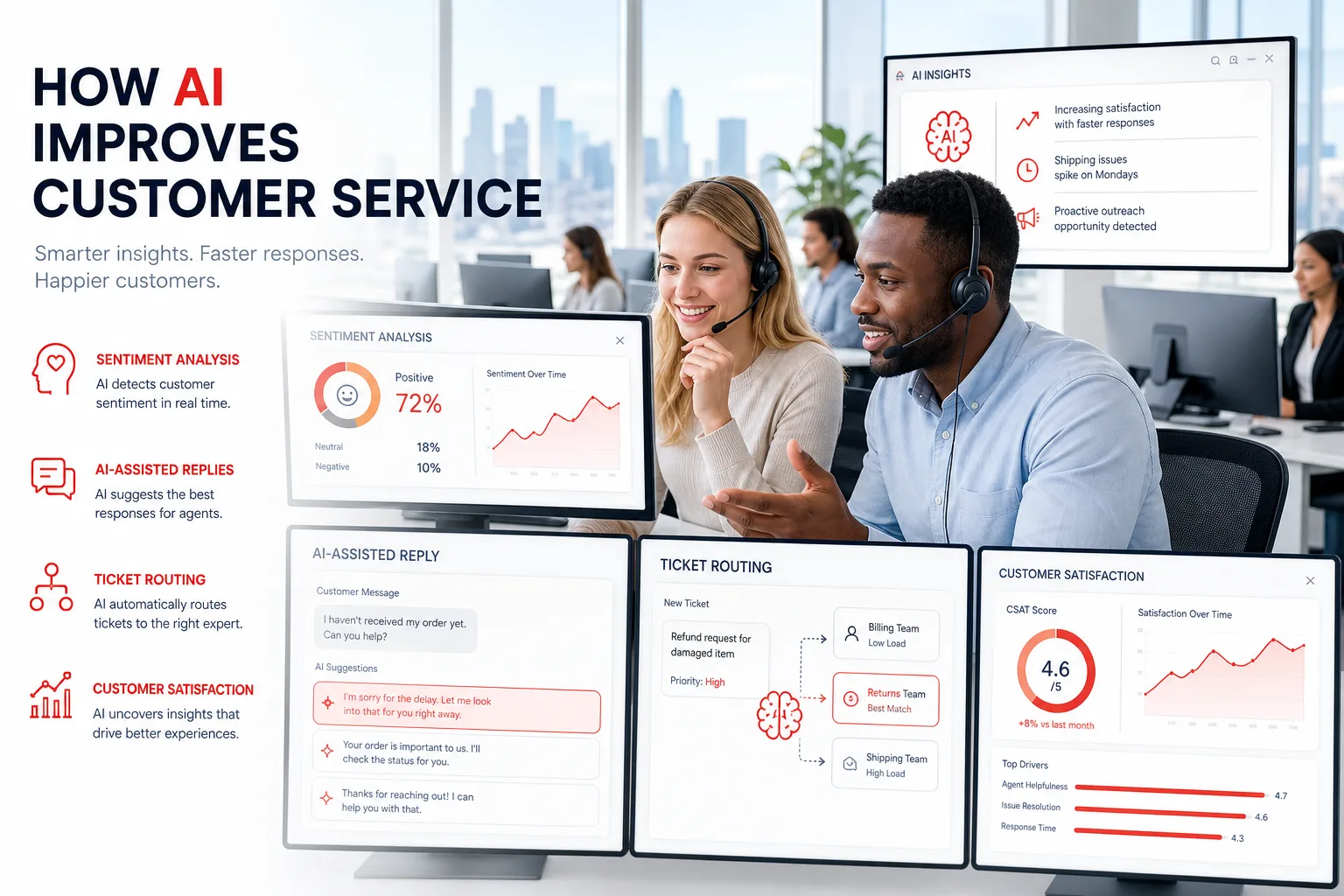
Customer service has become one of the most important factors influencing customer satisfaction and business growth. Today's customers expect quick responses, personalized interactions, and consistent support across multiple channels. Meeting these expectations using traditional support methods alone can be expensive and difficult to scale.
Artificial Intelligence (AI) is helping businesses transform customer service by automating repetitive tasks, assisting support teams, and delivering faster, more personalized experiences. Rather than replacing human agents, AI works alongside them to improve efficiency and allow support teams to focus on complex customer issues.
In this guide, we'll explore how AI is improving customer service, the technologies behind it, common business use cases, implementation best practices, and how businesses can successfully adopt AI-powered support solutions.
Why Customer Service Is Changing
Customers now interact with businesses through websites, mobile apps, social media, live chat, email, and messaging platforms.
They expect:
- Fast responses
- Accurate information
- Personalized experiences
- Self-service options
- Consistent support
- Availability outside normal business hours
Businesses that cannot meet these expectations often experience lower customer satisfaction and reduced customer retention.
AI helps organizations scale customer service without proportionally increasing support costs.
Customer service is one of the most common AI applications across industries. Our guide to top AI use cases across different industries shows how support automation appears in retail, healthcare, finance, SaaS, and many other sectors.
What Is AI-Powered Customer Service?
AI-powered customer service uses artificial intelligence technologies to assist customers and support teams.
These technologies include:
- AI chatbots
- Virtual assistants
- Natural Language Processing (NLP)
- Large Language Models (LLMs)
- Sentiment analysis
- Intelligent search
- Workflow automation
- Predictive analytics
Together, these technologies enable businesses to answer questions, automate support tasks, analyze customer interactions, and provide more personalized experiences.
For a deeper look at chatbot capabilities, read our guide to AI chatbots for business.
Benefits of AI in Customer Service
24/7 Customer Support
Customers often need assistance outside business hours.
AI-powered chatbots and virtual assistants can answer questions, provide account information, and guide users through common processes at any time.
This ensures customers receive support whenever they need it.
Faster Response Times
Long wait times are one of the biggest causes of customer frustration.
AI enables businesses to provide immediate responses for common requests such as:
- Order tracking
- Appointment scheduling
- Product information
- Account updates
- Password resets
- Billing questions
Faster responses improve the overall customer experience.
Reduced Support Costs
Many support requests involve repetitive questions.
AI automates these conversations, reducing the workload on customer service teams.
Support agents can then focus on complex issues that require human judgment and empathy.
Personalized Customer Experiences
AI can analyze customer data and previous interactions to provide more relevant assistance.
Examples include:
- Personalized recommendations
- Account-specific responses
- Product suggestions
- Tailored promotions
- Customized support journeys
Personalization helps customers feel understood and valued.
Improved Agent Productivity
AI does not only support customers. It also assists customer service teams.
AI can help agents by:
- Suggesting responses
- Summarizing conversations
- Retrieving knowledge base articles
- Prioritizing support tickets
- Drafting emails
This allows agents to resolve issues more quickly.
Common AI Customer Service Use Cases
AI Chatbots
AI chatbots answer frequently asked questions, guide users through processes, and collect information before transferring conversations to human agents.
Typical use cases include:
- Product inquiries
- Service information
- Pricing questions
- Order tracking
- Appointment scheduling
Virtual Customer Assistants
Virtual assistants provide more advanced conversational experiences than traditional chatbots.
They can:
- Understand context
- Remember previous conversations
- Complete tasks
- Recommend products
- Escalate complex requests
These assistants improve both customer satisfaction and operational efficiency.
Automated Ticket Routing
AI can analyze incoming requests and send them to the most appropriate department or support agent.
Benefits include:
- Faster issue resolution
- Reduced manual sorting
- Better workload distribution
- Improved customer satisfaction
Intelligent Knowledge Bases
AI-powered search allows customers and employees to quickly find accurate answers.
Knowledge bases can include:
- Product documentation
- User guides
- Troubleshooting articles
- Company policies
- Frequently asked questions
This improves self-service while reducing support requests.
Sentiment Analysis
AI can evaluate the tone of customer messages to identify frustration, urgency, or satisfaction.
Businesses use sentiment analysis to:
- Prioritize critical issues
- Identify unhappy customers
- Improve quality assurance
- Monitor customer satisfaction
Voice AI
Businesses increasingly use AI-powered voice assistants for customer support.
Applications include:
- Interactive voice response
- Appointment scheduling
- Order status
- Call routing
- Account verification
Voice AI creates faster and more convenient phone support experiences.
Industries Benefiting From AI Customer Service
AI customer service solutions create value across many industries.
Retail and eCommerce
- Product recommendations
- Order tracking
- Returns management
- Customer support
Healthcare
- Appointment scheduling
- Patient support
- Medical information
- Administrative assistance
Financial Services
- Account inquiries
- Fraud alerts
- Loan information
- Secure customer verification
Real Estate
- Property recommendations
- Viewing appointments
- Lead qualification
- Customer follow-up
Education
- Student support
- Course recommendations
- Enrollment assistance
- Administrative help
SaaS Companies
- Technical support
- Product onboarding
- Subscription management
- Knowledge base assistance
Best Practices for Implementing AI Customer Service
Define Clear Objectives
Identify what you want AI to achieve.
Examples include:
- Faster response times
- Reduced support costs
- Higher customer satisfaction
- Increased self-service adoption
Train AI With Accurate Information
An AI assistant is only as good as the information it can access.
Use:
- Product documentation
- Help articles
- Company policies
- Support history
- Internal knowledge bases
Regular updates improve response quality.
Maintain Human Support
AI should complement your support team, not replace it.
Customers should always have the option to speak with a human when necessary.
This creates a better overall experience for complex or sensitive issues.
Monitor Performance
Measure AI effectiveness using metrics such as:
- First response time
- Resolution rate
- Customer satisfaction
- Average handling time
- Ticket volume
- Escalation rate
Continuous monitoring helps improve both AI and human support processes.
For broader automation planning, review our guide to AI automation for businesses.
Common Challenges
Businesses should also consider potential challenges.
Examples include:
- Poor training data
- Privacy concerns
- Integration complexity
- Maintaining knowledge accuracy
- User adoption
Planning for these challenges helps ensure a smoother implementation.
Secure API development and integration is often essential when AI support tools need to connect with CRM, help desk, billing, and knowledge base platforms.
How Kodu Media Builds AI Customer Service Solutions
At Kodu Media, we help businesses create intelligent customer service experiences through practical AI solutions.
Our services include:
- AI consulting
- AI chatbot development
- Virtual assistant development
- Customer support automation
- CRM integration
- Knowledge base integration
- API development
- AI-powered mobile and web applications
- Workflow automation
- Ongoing optimization and maintenance
We focus on solutions that improve customer satisfaction while supporting long-term business growth.
Explore our dedicated AI chatbots and virtual assistants service, or learn how our AI development company and AI automation services support end-to-end customer service modernization.
We also integrate support AI into custom software development, mobile app development, and SaaS development projects when customer experience is part of the product.
Future Trends in AI Customer Service
Customer service technology continues to evolve.
Businesses can expect greater adoption of:
- Voice AI assistants
- Multilingual AI support
- Predictive customer service
- AI agents capable of completing business tasks
- Hyper-personalized customer interactions
- Deeper CRM integration
Organizations that begin adopting AI today will be better positioned to meet future customer expectations.
Final Thoughts
Artificial Intelligence is changing customer service by helping businesses deliver faster responses, personalized experiences, and more efficient support operations.
Rather than replacing human agents, AI empowers support teams by automating repetitive tasks, improving knowledge access, and enabling faster issue resolution.
Businesses that invest in AI-powered customer service can improve customer satisfaction, reduce operational costs, and create stronger long-term relationships with their customers.
If you're planning to modernize your customer support operations, Kodu Media can help you design, develop, and integrate AI solutions that align with your business goals.
Contact us today to discover how AI can transform your customer service strategy.
Frequently Asked Questions
Can AI completely replace customer support agents?
No. AI is best used to automate repetitive tasks and assist customers with common requests. Human agents remain essential for handling complex, sensitive, or high-value interactions.
Is AI customer service suitable for small businesses?
Yes. Small businesses can benefit from AI chatbots, automated responses, appointment scheduling, and customer self-service tools without requiring large support teams.
How does AI improve customer satisfaction?
AI provides faster responses, personalized assistance, 24/7 availability, and consistent support, helping customers resolve issues more quickly.
Can AI integrate with our CRM and help desk software?
Yes. AI solutions can integrate with CRM systems, ticketing platforms, knowledge bases, websites, mobile apps, and other business software using APIs.
Does Kodu Media build custom AI customer service solutions?
Yes. We design and develop AI-powered customer service platforms, chatbots, virtual assistants, workflow automation, and integrated support systems tailored to your business.