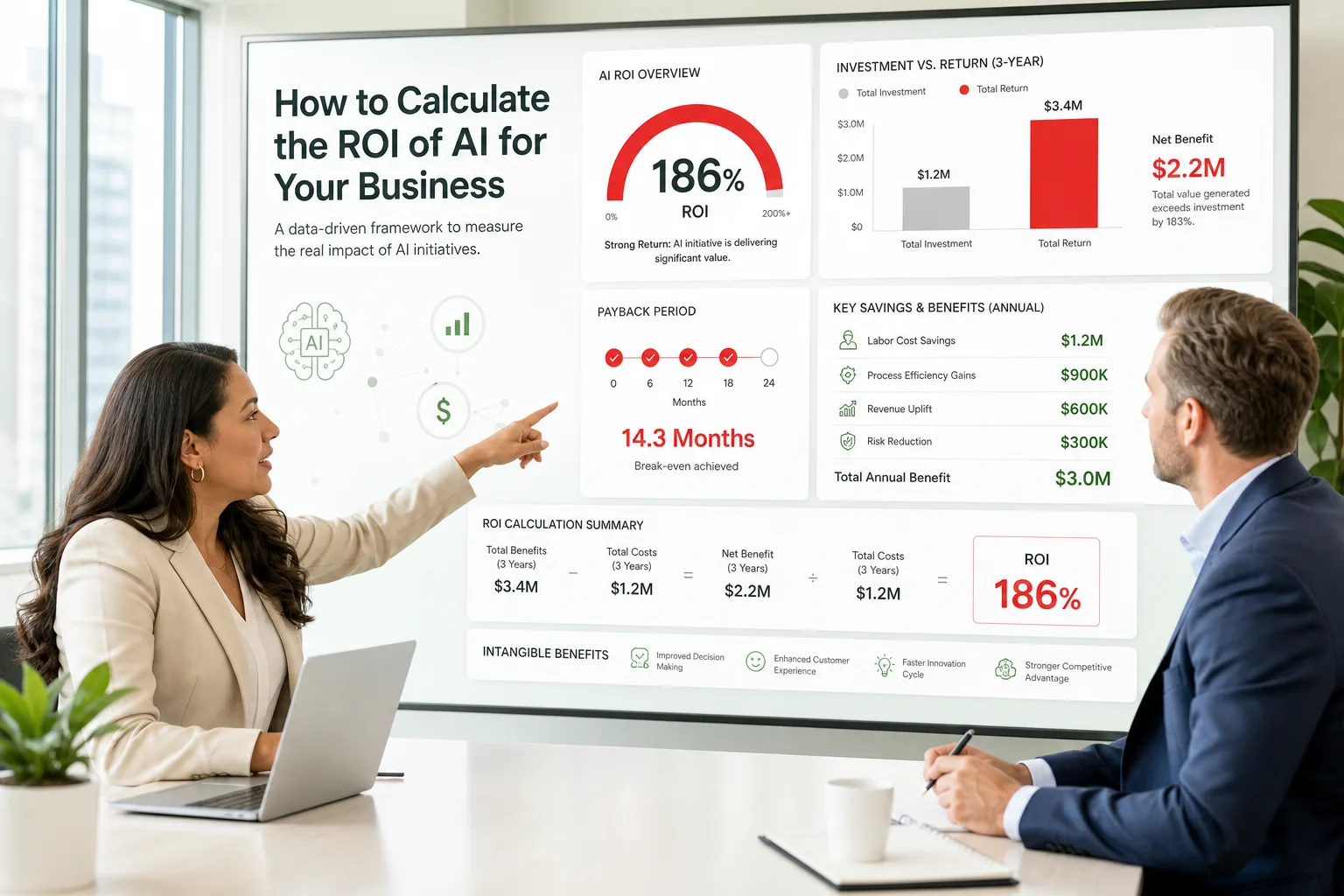
Artificial Intelligence is becoming a strategic investment for organizations looking to improve efficiency, automate operations, and enhance customer experiences. While AI has the potential to deliver significant business value, many decision-makers ask the same question before approving an AI project:
Will this investment generate a positive return?
Calculating the return on investment (ROI) of AI is not always straightforward. Unlike traditional software projects, AI often creates value through a combination of cost savings, productivity improvements, faster decision-making, increased revenue, and better customer satisfaction.
This guide explains how businesses can evaluate AI investments, measure success, and build a realistic business case before starting an AI project.
What Is ROI?
Return on Investment (ROI) measures how much value an investment generates compared to its total cost.
The basic formula is:
ROI = (Business Value - Total Investment) ÷ Total Investment × 100
While the calculation is simple, identifying the true business value of AI requires a broader view than direct financial gains alone.
Before estimating returns, understand the full investment side of the equation in our guide to AI software development cost in 2026.
Why Measuring AI ROI Matters
Measuring ROI helps businesses:
- Justify investment decisions
- Prioritize AI initiatives
- Compare projects
- Track business outcomes
- Improve future implementations
- Demonstrate value to stakeholders
Organizations that measure AI performance are better positioned to expand successful initiatives.
Types of Business Value AI Creates
AI delivers value in several ways.
Cost Reduction
AI can reduce operating expenses by:
- Automating repetitive tasks
- Lowering support costs
- Reducing manual processing
- Minimizing errors
- Improving resource allocation
AI automation for businesses often delivers measurable savings when workflows span support, finance, HR, and operations.
Productivity Improvements
Employees spend less time on repetitive work and more time on strategic activities.
Examples include:
- Faster document processing
- Automated reporting
- AI-assisted customer support
- Workflow automation
- Knowledge retrieval
Revenue Growth
AI can increase revenue by:
- Improving lead qualification
- Personalizing customer experiences
- Increasing conversion rates
- Recommending products
- Reducing abandoned carts
See AI in eCommerce for practical examples of how personalization, search, and support automation improve conversion and average order value.
Better Decision-Making
AI helps organizations make faster, data-driven decisions through:
- Predictive analytics
- Business forecasting
- Risk analysis
- Demand planning
- Customer insights
Better decisions often produce long-term financial benefits.
Predictive use cases depend on reliable data and the right AI approach. Review Machine Learning vs Artificial Intelligence and how businesses can prepare their data for AI when forecasting is part of your ROI model.
Identify the Costs of an AI Project
To calculate ROI accurately, include all project costs.
Typical expenses include:
- Discovery and planning
- AI consulting
- Software development
- Data preparation
- System integration
- Cloud infrastructure
- AI model usage
- Testing
- Employee training
- Ongoing maintenance
Looking only at development costs can produce an incomplete ROI calculation.
Also consider whether building custom AI software or buying an existing platform creates better long-term value for your use case.
Identify Measurable Benefits
Businesses should estimate improvements in measurable areas.
Examples include:
- Hours saved each week
- Reduction in support tickets
- Lower processing costs
- Faster response times
- Increased sales
- Improved customer retention
- Fewer operational errors
These improvements can often be translated into financial value.
For support-focused projects, baseline metrics from how AI improves customer service and AI chatbots for business help quantify response time, ticket volume, and satisfaction gains.
Key Metrics to Track
Common AI success metrics include:
- Cost savings
- Revenue growth
- Employee productivity
- Customer satisfaction
- Average response time
- Conversion rate
- Customer retention
- Processing time
- Error reduction
- Return on investment
Choose metrics that align with your business objectives.
| Metric Category | Example KPIs | Best For |
|---|---|---|
| Efficiency | Hours saved, processing time, error rate | Workflow automation and document processing |
| Customer experience | Response time, CSAT, retention | Chatbots and support automation |
| Revenue | Conversion rate, average order value, lead quality | Sales, marketing, and eCommerce AI |
| Operations | Forecast accuracy, inventory turns, fraud rate | Predictive analytics and planning |
Example ROI Scenario
Imagine a customer support team handling 5,000 inquiries each month.
After implementing an AI assistant:
- 60 percent of inquiries are resolved automatically.
- Average response time decreases significantly.
- Support agents focus on complex cases.
- Customer satisfaction improves.
- Operating costs decline.
In addition to direct savings, the business benefits from faster service and improved customer retention.
This demonstrates how AI can create value beyond simple cost reduction.
To estimate implementation cost for a project like this, compare chatbot, automation, and agent options in our AI software development cost guide and AI agents vs AI chatbots comparison.
Start With High-Impact Opportunities
Businesses often achieve the best ROI by beginning with one focused use case.
Examples include:
- Customer support automation
- Invoice processing
- Knowledge assistants
- Sales automation
- Document analysis
Quick wins build confidence and support future AI investments.
How AI is transforming modern businesses and top AI use cases across different industries can help you prioritize the use case with the strongest business case.
Common Mistakes When Measuring AI ROI
Avoid these common mistakes:
- Measuring only short-term results
- Ignoring employee productivity gains
- Overlooking customer experience improvements
- Failing to track baseline performance
- Choosing unrealistic success metrics
A balanced evaluation provides a more accurate picture of AI's value.
Best Practices for Maximizing AI ROI
Businesses can improve results by:
- Defining measurable goals before development
- Starting with an MVP
- Preparing quality data
- Training employees
- Monitoring AI performance regularly
- Continuously improving the solution
Successful AI projects evolve over time rather than remaining static.
Follow the MVP and planning approach in how to build an AI-powered application and partner selection guidance in how to choose the right AI development company to reduce risk while proving value early.
How Kodu Media Helps Businesses Measure AI Success
At Kodu Media, we focus on AI projects that deliver measurable business outcomes.
Our services include:
- AI consulting
- ROI assessment
- AI strategy
- Custom AI software development
- Workflow automation
- AI chatbot development
- Business analytics
- API integration
- Performance optimization
- Long-term AI support
We help businesses define success metrics before development begins so they can clearly measure the value of their investment.
Our AI development company team aligns project scope with business KPIs from discovery through launch. We also deliver AI automation services, AI chatbots and virtual assistants, and custom software development when AI must integrate with existing CRM, ERP, and operational systems.
For broader platform builds, we support API development and integration and enterprise software development so ROI can be tracked across the full business workflow.
Final Thoughts
Artificial Intelligence should be viewed as a business investment rather than simply a technology project.
The most successful organizations evaluate AI based on measurable improvements in efficiency, revenue, customer experience, and productivity.
By identifying clear objectives, tracking meaningful metrics, and focusing on high-impact opportunities, businesses can build AI solutions that deliver lasting value.
If you're considering AI for your organization, Kodu Media can help you identify opportunities, estimate potential ROI, and develop intelligent solutions that support long-term business growth.
Contact us today to schedule a consultation and learn how AI can generate measurable value for your business.
Frequently Asked Questions
How do you measure the ROI of AI?
Measure the financial value created through cost savings, revenue growth, productivity improvements, and customer experience enhancements, then compare those benefits with the total investment.
How long does it take to see a return from AI?
The timeline depends on the project, but many businesses begin seeing measurable improvements within the first several months after implementation.
Which AI projects usually deliver the fastest ROI?
Customer support automation, workflow automation, document processing, sales assistance, and knowledge management are common examples of high-impact projects.
Should every AI project have ROI goals?
Yes. Defining measurable objectives before development helps ensure the project remains aligned with business priorities.
Does Kodu Media help businesses estimate AI ROI?
Yes. We assess your business processes, identify AI opportunities, estimate potential returns, and develop solutions focused on measurable business outcomes.