Artificial Intelligence is no longer reserved for large technology companies. Businesses of every size are investing in AI to automate operations, improve customer experiences, analyze data, and increase productivity.
One of the first questions organizations ask before starting an AI project is:
"How much does AI software development cost?"
The answer depends on several factors, including project complexity, AI capabilities, integrations, data availability, security requirements, and long-term business goals.
Rather than focusing only on development costs, businesses should evaluate the long-term value AI can deliver through increased efficiency, reduced operating costs, and improved customer experiences.
This guide explains the factors that influence AI software development costs and helps you understand what to consider before starting your project.
Why AI Development Costs Vary
Every AI project is different.
A simple AI chatbot requires significantly less effort than an enterprise AI platform that integrates with multiple business systems.
Project costs are influenced by:
- Business requirements
- AI functionality
- Data availability
- Software integrations
- User interface complexity
- Security requirements
- Compliance requirements
- Cloud infrastructure
- Ongoing maintenance
Understanding these factors helps businesses create realistic budgets.
If you're deciding between custom development and off-the-shelf platforms, read build vs buy AI software before setting your budget expectations.
Types of AI Projects
AI Chatbots
Businesses commonly build AI chatbots for:
- Customer support
- Sales assistance
- Appointment scheduling
- Internal knowledge management
- Employee support
Chatbot complexity depends on integrations, business workflows, and knowledge sources.
See AI chatbots for business for a deeper look at features, use cases, and implementation considerations.
AI Workflow Automation
Organizations automate repetitive processes such as:
- Invoice processing
- Document analysis
- Email classification
- HR workflows
- Customer onboarding
- Business approvals
Workflow automation often delivers rapid operational improvements.
Review AI automation for businesses when automation spans CRM, finance, HR, and operations platforms.
AI-Powered Business Applications
Examples include:
- CRM platforms
- ERP extensions
- Business dashboards
- Sales intelligence tools
- Customer portals
- Internal productivity systems
These applications combine traditional software development with AI capabilities.
Explore custom AI software development when AI is part of a broader business platform rather than a standalone tool.
Predictive Analytics
Businesses use predictive AI for:
- Sales forecasting
- Customer churn prediction
- Inventory planning
- Fraud detection
- Financial analysis
- Demand forecasting
These solutions rely heavily on historical business data.
Predictive projects often depend on Machine Learning and clean historical records prepared through data readiness work.
Generative AI Applications
Examples include:
- Content generation
- Proposal writing
- AI assistants
- Document summarization
- Code generation
- Knowledge management
Generative AI applications often combine Large Language Models with custom business data.
See Generative AI vs Traditional AI to understand when generative models are the right fit versus predictive or rule-based systems.
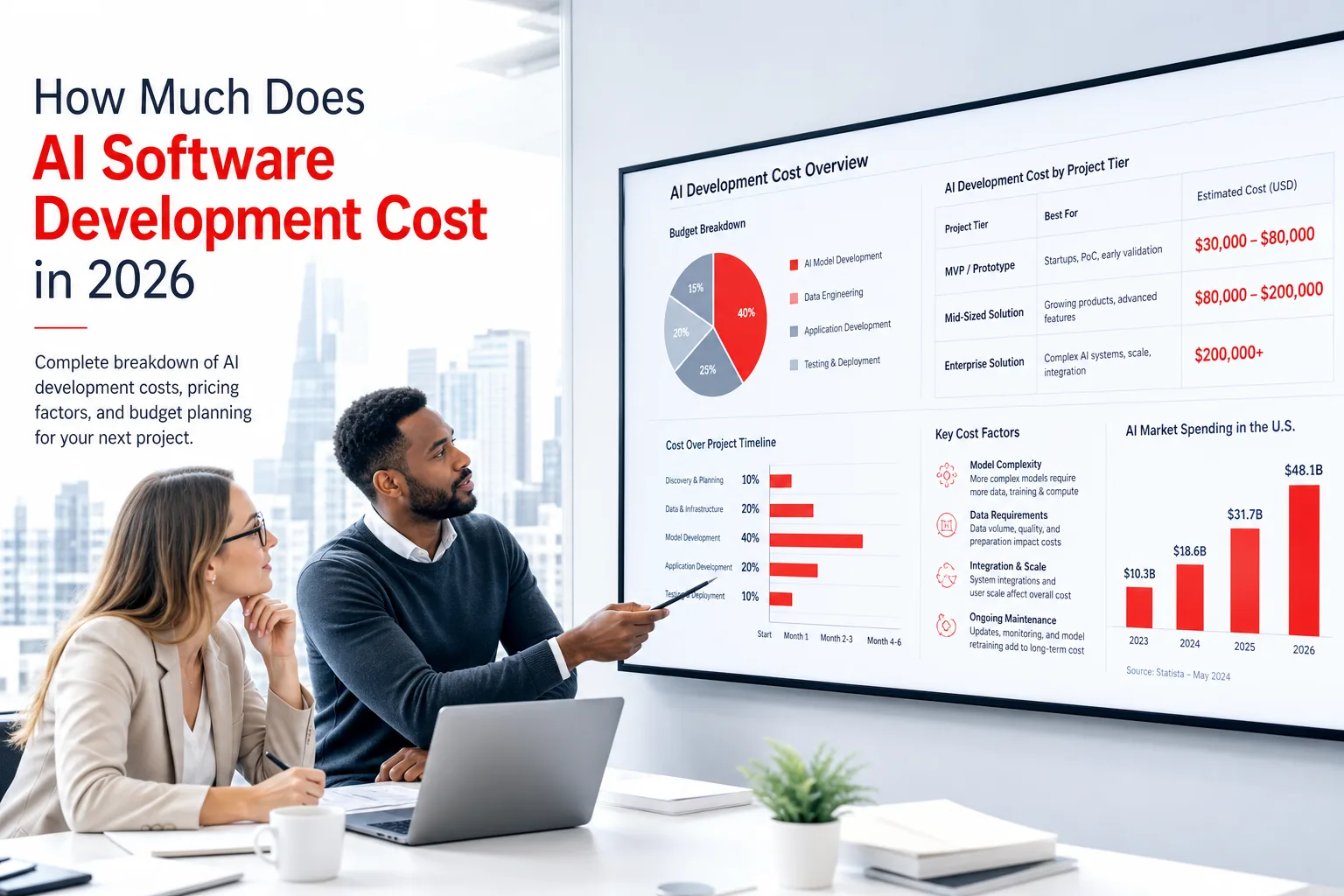
AI Software Development Cost Overview in 2026
Professional AI development typically falls into these ranges. These are starting points based on common project types, not fixed quotes for every business.
| Project Type | Typical Starting Investment | Best For |
|---|---|---|
| AI Chatbot | Starting at $1,500 | Customer support, lead capture, and FAQ automation |
| AI Workflow Automation | Starting at $2,500 | CRM, email, document, and process automation |
| AI Agent Development | Starting at $5,000 | Multi-step business tasks with integrations and knowledge bases |
| Custom AI Application | Custom quote | Enterprise platforms, predictive analytics, and SaaS products |
For a full breakdown of packages, see our AI automation pricing.
Factors That Affect AI Development Costs
Project Complexity
The number of features has a significant impact on development effort.
Examples include:
- User authentication
- AI conversations
- Workflow automation
- Analytics dashboards
- Reporting
- Multi-language support
- Role-based permissions
More complex projects require additional design, development, and testing.
Data Preparation
AI depends on high-quality data.
Businesses may need to:
- Clean existing data
- Organize documents
- Remove duplicates
- Integrate multiple systems
- Prepare knowledge bases
Data preparation often represents a significant portion of an AI project.
Integrations
AI rarely works in isolation.
Common integrations include:
- CRM systems
- ERP software
- Accounting platforms
- Customer support tools
- Websites
- Mobile applications
- Cloud storage
- Internal databases
The number and complexity of integrations affect development time.
API development and integration is often required when AI must read from or update multiple business systems securely.
User Experience
Successful AI applications require intuitive interfaces.
Design work may include:
- User research
- Wireframes
- Dashboard design
- Chat interfaces
- Mobile optimization
- Accessibility improvements
A better user experience often improves adoption and productivity.
Strong UI/UX design is especially important when employees or customers interact with AI daily.
Security
Businesses handling sensitive information require stronger security.
Examples include:
- Secure authentication
- Role-based access
- Data encryption
- Audit logs
- Compliance support
- API security
Security requirements vary by industry.
Additional Costs to Consider
Businesses should also budget for:
- Cloud hosting
- AI model usage
- API costs
- Software licensing
- Monitoring
- Maintenance
- Security updates
- Feature enhancements
- User training
Considering ongoing operational costs helps avoid surprises after launch.
How to Reduce AI Development Costs
Businesses can improve cost efficiency by following several best practices.
Start With One High-Value Use Case
Instead of automating every process, focus on the area with the highest business impact.
Build an MVP
Launch a Minimum Viable Product with essential AI capabilities before expanding functionality.
This approach mirrors the MVP strategy used in how to build an AI-powered application and helps validate ROI before scaling.
Use Existing Business Data
Well-organized existing data reduces preparation time and improves AI accuracy.
Choose the Right Technology
Selecting the appropriate AI models and architecture helps balance performance and long-term operating costs.
For advanced automation, compare whether you need a chatbot, an AI agent, or a broader custom platform before expanding scope.
Questions to Ask Before Starting an AI Project
Before investing in AI, consider:
- What business problem are we solving?
- What data do we already have?
- Which systems require integration?
- How will we measure success?
- What level of automation do we need?
- What are our security requirements?
Answering these questions creates a stronger foundation for planning.
Once your budget is defined, use how to choose the right AI development company to evaluate partners before signing a contract.
Why Businesses Choose Kodu Media
At Kodu Media, we design AI solutions around measurable business outcomes.
Our services include:
- AI consulting
- Business analysis
- AI chatbot development
- Custom AI software development
- Workflow automation
- API integration
- SaaS development
- Mobile AI applications
- Cloud deployment
- Long-term support
Every project begins with understanding your business goals before recommending the most appropriate AI approach.
Our AI development company team provides scoped proposals based on your use case, integrations, and long-term roadmap. We also deliver SaaS development, custom software development, and mobile app development when AI is part of a larger product strategy.
Final Thoughts
AI software development costs depend on far more than the technology itself. Project scope, integrations, data quality, user experience, security, and long-term maintenance all influence the total investment.
The most successful AI projects focus on solving specific business challenges while delivering measurable operational improvements and long-term value.
Rather than searching for the lowest development cost, businesses should evaluate the return on investment AI can provide through improved efficiency, better customer experiences, and increased productivity.
If you're planning an AI project, Kodu Media can help you define your requirements, estimate development costs, and build an AI solution tailored to your business.
Contact us today to schedule a free consultation.
Frequently Asked Questions
Why does AI software development cost vary so much?
Every project has different requirements, including AI capabilities, integrations, security, user experience, and data preparation. These factors influence the overall development effort.
Can small businesses afford AI development?
Yes. Many businesses begin with focused AI solutions such as chatbots, workflow automation, or document processing before expanding into more advanced applications.
Is custom AI more expensive than off-the-shelf software?
Custom AI generally requires a higher initial investment but provides greater flexibility, ownership, and long-term scalability.
How can I reduce AI development costs?
Start with a clear business objective, build an MVP, prepare your data, and prioritize high-impact features before expanding the solution.
Does Kodu Media provide AI project estimation?
Yes. We evaluate your business requirements, recommend the appropriate technology stack, define the project scope, and provide a tailored development proposal.