Hiring the wrong website development agency can cost thousands of dollars, delay your launch, and damage SEO you already earned. Before you sign a contract, ask these essential questions.
This checklist is for founders, CEOs, and marketing managers who are already planning to hire. You are not browsing tutorials. You are trying to avoid a bad vendor decision on a project that may run from about $5,000 to well into six figures.
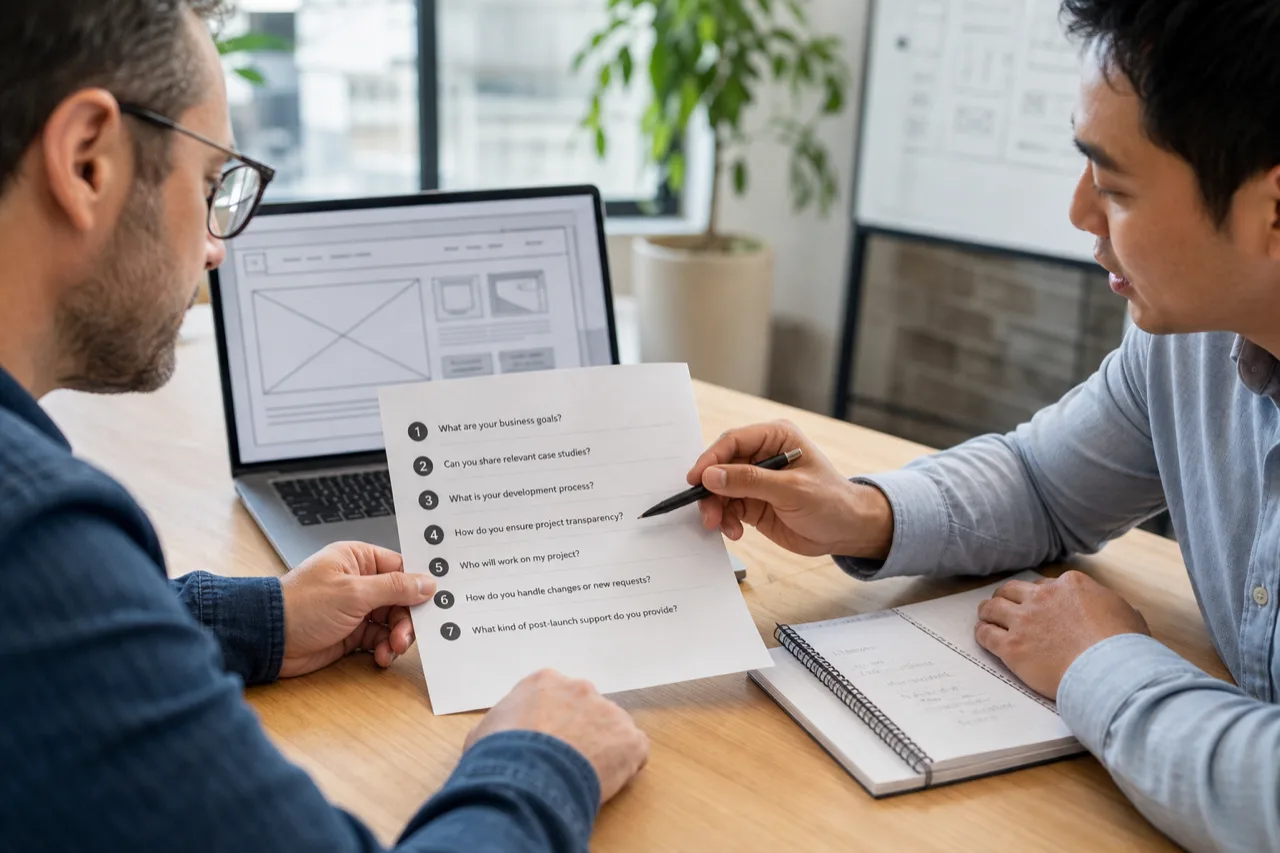
Use this page as your discovery-call script. For the broader evaluation framework, see How to Choose a Website Development Company in the USA. For budget bands, see How Much Does a Website Cost in the USA?.
We encourage every client to ask these questions before hiring any agency, including Kodu Media.
Quick Checklist (Print or Share With Your Team)
| # | Question | What a strong answer includes |
|---|---|---|
| 1 | Who will actually build my website? | Named roles, not only sales people |
| 2 | Will I own the source code? | Clear ownership and admin access |
| 3 | Custom or template-based? | Tradeoffs tied to your goals |
| 4 | How will you optimize SEO? | Architecture, performance, migration plan |
| 5 | How will you improve speed? | Measurable performance approach |
| 6 | What happens after launch? | Support scope and response model |
| 7 | How do you handle security? | Updates, backups, access control |
| 8 | Can the site grow with us? | Scaling path beyond launch v1 |
| 9 | How do you communicate? | Cadence, tools, decision owners |
| 10 | Can I see similar projects? | Relevant case studies or references |
Bring this table to every sales call. Compare answers side by side.
Question 1: Who Will Actually Build My Website?
Ask who designs, develops, manages the project, and handles QA. Many agencies sell with senior talent and deliver with undertrained juniors or opaque subcontractors.
Ask for:
- Roles on your project (PM, designer, developer, QA)
- Whether work is in-house, subcontracted, or mixed
- Who your day-to-day contact will be
- Who makes technical decisions when tradeoffs appear
Strong answer: Named roles, clear accountability, and no surprise outsourcing mid-project.
Weak answer: “Our team handles everything” with no names, no process, and no escalation path.
Why it matters: communication quality and craft quality are inseparable on business websites that need to generate leads.
Question 2: Will I Own the Source Code?
Ownership is non-negotiable for serious US businesses. If you cannot leave, you do not own the asset.
Ask for:
- Who owns code, design files, and content after payment
- Whether you receive full admin access from day one
- Where repositories and staging environments live
- License terms for themes, plugins, fonts, and stock assets
- What happens if you change agencies later
Strong answer: You own (or clearly license) what you paid for, with full access documented in the proposal.
Weak answer: Proprietary lock-in, withheld credentials, or “we manage everything so you do not need access.”
Related hiring depth: How to Choose a Website Development Company in the USA.
Question 3: Will the Website Be Custom or Template-Based?
Neither approach is automatically wrong. The wrong fit for your growth stage is expensive.
Ask for:
- Template-assisted, custom theme/components, or fully custom application
- Why that approach fits your goals for the next 24 months
- What becomes hard to change later
- Editor experience for your marketing team
- How brand differentiation is handled
Strong answer: A recommendation tied to outcomes (lead gen, commerce, portal needs), not dogma.
Weak answer: One default stack for every client, or a cheap theme with no discussion of limitations.
If WordPress is on the table, compare approaches in Custom WordPress Development vs WordPress Themes and Custom WordPress Development vs Page Builders.
Question 4: How Will You Optimize SEO?
SEO is not a plugin install at the end. It is architecture, content structure, performance, metadata patterns, and migration discipline.
Ask for:
- How information architecture supports search intent
- Technical foundations (crawlability, schema readiness, clean URLs)
- Who owns metadata patterns and internal linking structure
- Redirect and URL mapping process for redesigns
- How they avoid ranking loss during launch
Strong answer: SEO is built into discovery and development, with a migration plan when URLs change.
Weak answer: “We install Yoast / Rank Math” as the entire SEO strategy, or guaranteed #1 ranking promises.
Redesign SEO context: WordPress Website Redesign Guide.
Question 5: How Will You Improve Website Speed?
Speed affects SEO, Google Ads conversion rates, and trust. Ask for a performance plan, not a hope.
Ask for:
- Target metrics (for example Core Web Vitals on key templates)
- Image, script, and hosting approach
- How staging performance is validated before launch
- What is in scope vs later optimization
- Who monitors speed after go-live
Strong answer: Measurable targets, lean front-end practices, and pre-launch checks on real devices.
Weak answer: “It will be fast” with no method, or heavy page-builder stacks sold as enterprise quality.
If paid search is part of your plan, slow landing pages raise cost per lead even when campaigns are well managed.
Question 6: What Happens After Launch?
Launch day is not the finish line. Updates, backups, security patches, and content changes continue.
Ask for:
- What the post-launch warranty covers and for how long
- Maintenance retainer options and response times
- Who handles plugin/platform updates
- How emergencies are triaged
- Training for your internal team
Strong answer: A written support model with inclusions, exclusions, and clear ownership after go-live.
Weak answer: “Call us if something breaks” with no retainer, no SLA language, and no monitoring.
Kodu Media maintenance plans start on our pricing page.
Question 7: How Do You Handle Security?
A business website stores forms, customer data pathways, and often admin access to marketing systems. Security is part of development quality.
Ask for:
- Access control practices (who has production credentials)
- Backup frequency and restore testing
- Update cadence for platform, plugins, and dependencies
- Staging vs production separation
- How they handle vulnerabilities after launch
Strong answer: Least-privilege access, regular updates, tested backups, and a clear incident process.
Weak answer: Shared logins, no staging, and “security plugins” as a substitute for process.
Question 8: Can the Website Grow With My Business?
Your v1 site should not trap your v2 business. Ask about the growth path before you buy the foundation.
Ask for:
- How easy it is to add landing pages, services, locations, or blog resources
- Path to eCommerce, portals, CRM automation, or AI features later
- What would require a rebuild vs an iteration
- Content model flexibility for marketers
- Integration readiness (CRM, payments, booking, ERP)
Strong answer: A scalable architecture with honest “phase two” boundaries.
Weak answer: A rigid template that needs replacement as soon as you add real operations.
Service paths when growth includes more than a brochure site:
Question 9: How Do You Communicate During the Project?
Missed launches are often communication failures wearing a technical costume.
Ask for:
- Project cadence (weekly updates, demos, decision checkpoints)
- Tools used (email, project board, shared docs)
- Who approves scope changes
- How blockers are escalated
- Expected response times during the build
Strong answer: Written communication plan, milestone reviews, and a single accountable owner.
Weak answer: Ad hoc chats, no timeline, and no record of decisions.
US buyers, including teams in markets like San Diego, usually need US-friendly hours and clear written assumptions. Prioritize that over flashy decks.
Question 10: Can I See Projects Similar to Mine?
Relevance beats volume. A hundred unrelated portfolio pieces do not prove fit.
Ask for:
- Two or three projects similar in goals (lead gen, eCommerce, B2B, redesign)
- What problem they solved and what constraints existed
- What they would do differently now
- A reference you can speak with when appropriate
- Whether they have experience supporting SEO and Google Ads landing needs
Strong answer: Relevant examples plus honest tradeoffs from those builds.
Weak answer: Generic template galleries with no outcomes, no process story, and no references.
Bonus Questions Worth Asking on the Same Call
If time allows, add these:
- What is excluded from this quote?
- How do you validate analytics and conversion events before launch?
- Who owns DNS, hosting, and domain registrar access?
- How many revision rounds are included?
- What assumptions does this estimate depend on?
These five often expose hidden cost and timeline risk faster than another portfolio slide.
Red Flags That Should Pause the Hire
Walk away or renegotiate when you see:
- No documentation or vague proposals
- Very low pricing with no scope detail
- No staging environment
- No maintenance path after launch
- No testing / QA plan
- No timeline or milestones
- Ownership lock-in or withheld admin access
- Guaranteed ranking promises
- Pressure to sign before discovery is complete
Cheap websites usually cut information architecture, conversion UX, performance work, SEO migration discipline, and integration testing. Then companies pay again through rebuilds and wasted ad spend. Budget context: How Much Does a Website Cost in the USA?.
What Bad Answers Sound Like (Listen for These Phrases)
| Topic | Warning phrase | What it usually means |
|---|---|---|
| Ownership | “You will not need access.” | Lock-in risk |
| SEO | “We guarantee page one.” | Sales theater |
| Speed | “It will be fast enough.” | No measurement plan |
| Support | “Just email us anytime.” | No maintenance model |
| Process | “We are flexible on everything.” | No governance |
| Pricing | “We can do it for much less.” | Scope not defined |
Good partners welcome hard questions. Weak partners rush past them.
If You Run Google Ads, Add These Follow-Ups
- Which templates are designed for paid landing traffic?
- How do you validate form and conversion events before launch?
- What Core Web Vitals targets apply to ad landing pages?
- How quickly can we launch new campaign pages after go-live?
Paid acquisition makes website quality a media-efficiency issue. A cheaper build that converts poorly is more expensive than a stronger build that lowers cost per lead.
How to Use These Questions in a Two-Week Hire
Days 1-2
Write your brief: goals, must-haves, integrations, budget band, timeline, SEO/ads plans.
Days 3-5
Shortlist three agencies. Send the same brief to each.
Days 6-8
Run discovery calls using all 10 questions. Score answers 1-5 in one sheet.
Days 9-10
Compare proposals on inclusions, exclusions, ownership, and support, not only total price.
Decision
Hire the partner whose answers are specific, measurable, and comfortable under scrutiny.
Sample Scorecard You Can Copy
| Criterion | Agency A | Agency B | Agency C |
|---|---|---|---|
| Team clarity (Q1) | |||
| Ownership / access (Q2) | |||
| Build approach fit (Q3) | |||
| SEO plan (Q4) | |||
| Speed plan (Q5) | |||
| Post-launch support (Q6) | |||
| Security process (Q7) | |||
| Scalability (Q8) | |||
| Communication (Q9) | |||
| Relevant proof (Q10) | |||
| Proposal clarity | |||
| Total |
Use the same scorecard for every vendor. Consistency protects you from charm bias.
Why Businesses Choose Kodu Media
We encourage every client to ask these questions before hiring any agency, including us.
Companies work with Kodu Media when they want:
- Clear ownership and admin access
- Honest custom vs template recommendations
- SEO and performance built into delivery
- Support options after launch
- A partner that can grow from website work into WooCommerce, web applications, or AI workflows when needed
We will answer these questions in plain language, put assumptions in writing, and recommend the smallest effective scope for your goals.
Explore:
- Services
- WordPress Development Company
- WooCommerce Development Company
- Custom Software Development Company
- AI Automation Services
- Pricing
Frequently Asked Questions
What questions should I ask before hiring a website development company?
Start with ownership, who builds the site, custom vs template approach, SEO, speed, post-launch support, security, scalability, communication, and proof of similar work. This page covers each in detail.
How do I hire a web development company without getting oversold?
Share one written brief with every shortlist candidate, ask the same 10 questions, and compare scoped proposals. Prefer specific process answers over vague promises.
What is a website development checklist for first-time buyers?
Define goals, integrations, budget band, and success metrics; shortlist three agencies; run this question set; score answers; verify ownership and support terms before signing.
Should I ask about SEO before hiring web developers?
Yes. SEO foundations and migration discipline are part of development quality. If organic growth matters, treat SEO questions as mandatory.
How important is website speed when choosing an agency?
Very, especially if you run Google Ads or compete in high-intent search. Ask for measurable performance targets and pre-launch validation.
What red flags mean I should not hire an agency?
No documentation, unrealistically low pricing, no staging, no maintenance, no QA, no timeline, ownership lock-in, and guaranteed rankings.
Do I need custom development or is a template enough?
It depends on brand, conversion needs, editor workflows, and growth plans. Ask the agency to justify the approach for your next 24 months, not only launch day.
Who should own the website after launch?
You should. Retain admin access and clear ownership terms even if an agency manages hosting or updates under a retainer.
How many agencies should I interview?
Three is usually enough for a fair comparison on business website projects.
Can these questions be used for WordPress, WooCommerce, and custom apps?
Yes. The questions are platform-agnostic. The answers should change based on whether you need a marketing site, store, portal, or AI-enabled workflows.
What should be in the proposal after I ask these questions?
Scope, exclusions, timeline, ownership, SEO/migration plan if relevant, support terms, assumptions, and pricing. If those are missing, keep negotiating or keep shopping.
How does this checklist relate to choosing a company overall?
This article is the interview script. The broader framework lives in How to Choose a Website Development Company in the USA.
Related Services and Guides
- Services
- WordPress Development Company
- WooCommerce Development Company
- Custom Software Development Company
- AI Automation Services
- Pricing
- How to Choose a Website Development Company in the USA
- How Much Does a Website Cost in the USA?
- Why Cheap Websites Cost More in the Long Run
- Website Redesign vs Building a New Website
- How to Choose the Right WordPress Development Company
- WordPress Website Redesign Guide
- WordPress vs Webflow
- Custom WordPress Development vs WordPress Themes
Book a Discovery Call
If you are hiring a website development agency and want direct answers to these questions, Kodu Media is ready for that conversation.
Bring your goals, must-have features, timeline, and channel plans (SEO, Google Ads, or both). We will walk through scope, ownership, and the smallest effective path forward.
Book a discovery call · Request a custom quote · View pricing packages