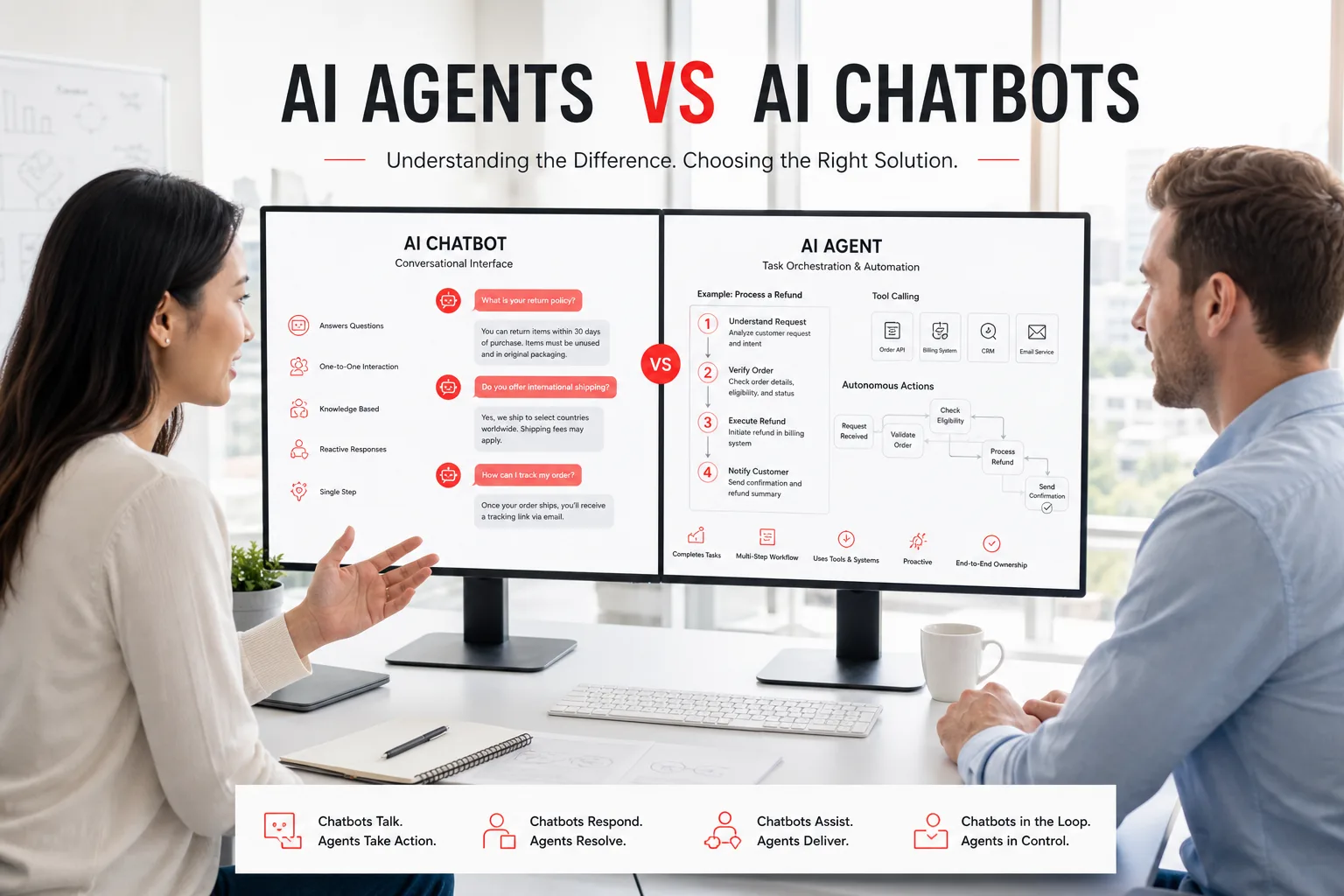
Artificial Intelligence is evolving rapidly, and businesses now have access to much more than traditional chatbots. One of the biggest developments is the rise of AI agents, intelligent systems capable of planning tasks, making decisions, using multiple tools, and completing workflows with minimal human intervention.
While AI chatbots remain valuable for customer support and conversational experiences, AI agents represent the next generation of business automation.
Understanding the difference helps organizations choose the right technology based on their business goals.
In this guide, we'll compare AI agents and AI chatbots, explain how they work, explore their strengths, and discuss when each approach makes the most sense.
What Is an AI Chatbot?
An AI chatbot is designed to communicate with users through natural conversations.
Modern AI chatbots can:
- Answer customer questions
- Explain products and services
- Schedule appointments
- Provide recommendations
- Assist with troubleshooting
- Collect customer information
- Transfer conversations to human agents
Their primary role is communication.
Most businesses use chatbots on websites, mobile apps, WhatsApp, and customer support platforms.
For a deeper look at chatbot capabilities, read our guide to AI chatbots for business.
What Is an AI Agent?
An AI agent goes beyond conversation.
Instead of only answering questions, it can perform actions, complete tasks, and make decisions based on business rules and available data.
Depending on its permissions, an AI agent can:
- Read emails
- Create reports
- Update CRM records
- Schedule meetings
- Analyze documents
- Generate proposals
- Monitor business systems
- Trigger workflows
- Interact with multiple software platforms
- Complete multi-step tasks
An AI agent behaves more like a digital employee than a conversational assistant.
AI Agents vs AI Chatbots at a Glance
| Feature | AI Chatbot | AI Agent |
|---|---|---|
| Primary Purpose | Conversation | Task execution and automation |
| Understands Natural Language | Yes | Yes |
| Completes Business Tasks | Limited | Yes |
| Multi-Step Reasoning | Limited | Advanced |
| Uses Multiple Tools | Sometimes | Yes |
| Workflow Automation | Basic | Advanced |
| CRM Integration | Yes | Yes |
| Decision Making | Limited | More autonomous |
| Best For | Customer communication | Business automation |
If you're comparing broader AI categories, our guide on Generative AI vs Traditional AI explains how different AI technologies fit different business goals.
How AI Chatbots Work
AI chatbots typically:
- Receive a customer question.
- Understand the user's intent.
- Search relevant knowledge.
- Generate a response.
- Escalate to a human if necessary.
Their goal is to answer questions efficiently.
How AI Agents Work
AI agents follow a more advanced process.
They can:
- Understand a goal.
- Break the task into smaller steps.
- Decide which tools are needed.
- Execute multiple actions.
- Verify results.
- Continue working until the objective is complete.
This makes them suitable for much more complex business operations.
Business Use Cases for AI Chatbots
AI chatbots work well for customer-facing interactions.
Examples include:
- Customer support
- Frequently asked questions
- Lead qualification
- Appointment booking
- Order tracking
- Product recommendations
- Website assistance
These applications improve response times while reducing support workloads.
See how AI improves customer service for a broader look at support automation strategies.
Business Use Cases for AI Agents
AI agents support internal operations and business automation.
Examples include:
- Sales automation
- CRM updates
- Invoice processing
- Employee onboarding
- Report generation
- Data analysis
- Proposal creation
- Workflow management
- Vendor communication
- Internal knowledge assistants
These tasks involve multiple systems and decision points.
Many of these use cases overlap with AI automation for businesses when workflows span CRM, finance, HR, and operations platforms.
Benefits of AI Chatbots
Businesses choose chatbots because they:
- Improve customer service
- Reduce response times
- Lower support costs
- Increase lead generation
- Provide 24/7 availability
- Improve customer satisfaction
Chatbots are often the first step in an AI adoption strategy.
Benefits of AI Agents
AI agents provide broader business value.
Benefits include:
- Process automation
- Higher employee productivity
- Reduced manual work
- Faster decision-making
- Better operational efficiency
- Integration across business systems
- Continuous task execution
- Improved scalability
AI agents help organizations automate work that previously required multiple employees or systems.
Can AI Agents and Chatbots Work Together?
Yes.
Many organizations use both technologies together.
For example:
A chatbot answers a customer's question about an order.
If the customer requests a refund, an AI agent can:
- Verify the purchase
- Check company policies
- Create the refund request
- Update the CRM
- Notify the finance team
- Send a confirmation email
The chatbot handles communication while the AI agent performs the business process.
Which Solution Is Right for Your Business?
Choose an AI chatbot if you need:
- Customer support
- Website assistance
- Lead generation
- Appointment scheduling
- Product recommendations
- FAQ automation
Choose an AI agent if you need:
- Business process automation
- Workflow management
- Document processing
- Multi-system integration
- Internal productivity
- Intelligent task execution
Some organizations benefit from implementing both.
Our guide on how to build an AI-powered application can help you plan the right starting point based on your goals, data, and integrations.
Common Challenges
Businesses should consider:
- Data security
- User permissions
- Integration complexity
- Change management
- AI governance
- Monitoring and maintenance
Planning these areas early improves long-term success.
Secure API development and integration is often essential when agents and chatbots need access to CRM, ERP, support, and finance systems.
Future of AI Agents
AI agents are expected to become increasingly capable.
Future developments may include:
- Greater autonomy
- Team-based AI agents
- Cross-platform collaboration
- Advanced business reasoning
- Industry-specific AI specialists
- Deeper enterprise integrations
Businesses that adopt AI agents strategically can improve efficiency while preparing for future innovation.
How Kodu Media Builds AI Solutions
At Kodu Media, we help businesses identify where AI creates the greatest value.
Our services include:
- AI consulting
- AI chatbot development
- AI agent development
- Workflow automation
- Custom AI software
- CRM integration
- API development
- Mobile and web AI integration
- Business process automation
- Ongoing optimization
We design intelligent systems that improve customer experiences, automate operations, and support long-term business growth.
Explore our AI chatbots and virtual assistants service, AI automation services, and AI development company capabilities for end-to-end implementation.
We also build agent and chatbot solutions within custom software development, mobile app development, and SaaS development projects when AI is part of a larger product roadmap.
Final Thoughts
AI chatbots and AI agents both play important roles in modern business, but they solve different problems.
Chatbots excel at conversations and customer interactions, while AI agents automate business tasks, connect multiple systems, and complete complex workflows.
Many organizations achieve the best results by combining both technologies into a unified AI strategy.
If you're exploring AI for your business, Kodu Media can help you determine whether an AI chatbot, an AI agent, or a complete AI automation solution is the right choice.
Contact our team today to discuss your AI strategy and discover how intelligent automation can transform your business.
Frequently Asked Questions
What is the difference between an AI chatbot and an AI agent?
An AI chatbot focuses on conversations and customer interactions. An AI agent can communicate, make decisions, use software tools, and complete business tasks.
Can AI agents replace employees?
AI agents automate repetitive and structured work, allowing employees to focus on strategic, creative, and customer-facing responsibilities.
Do AI agents use Large Language Models?
Many modern AI agents use Large Language Models along with APIs, business rules, memory, and workflow automation to complete tasks.
Can an AI chatbot become an AI agent?
Yes. By adding tool access, workflow automation, and decision-making capabilities, a chatbot can evolve into a more capable AI agent.
Does Kodu Media develop AI agents?
Yes. We design and develop AI agents, AI chatbots, workflow automation systems, and custom AI solutions that integrate with existing business software.