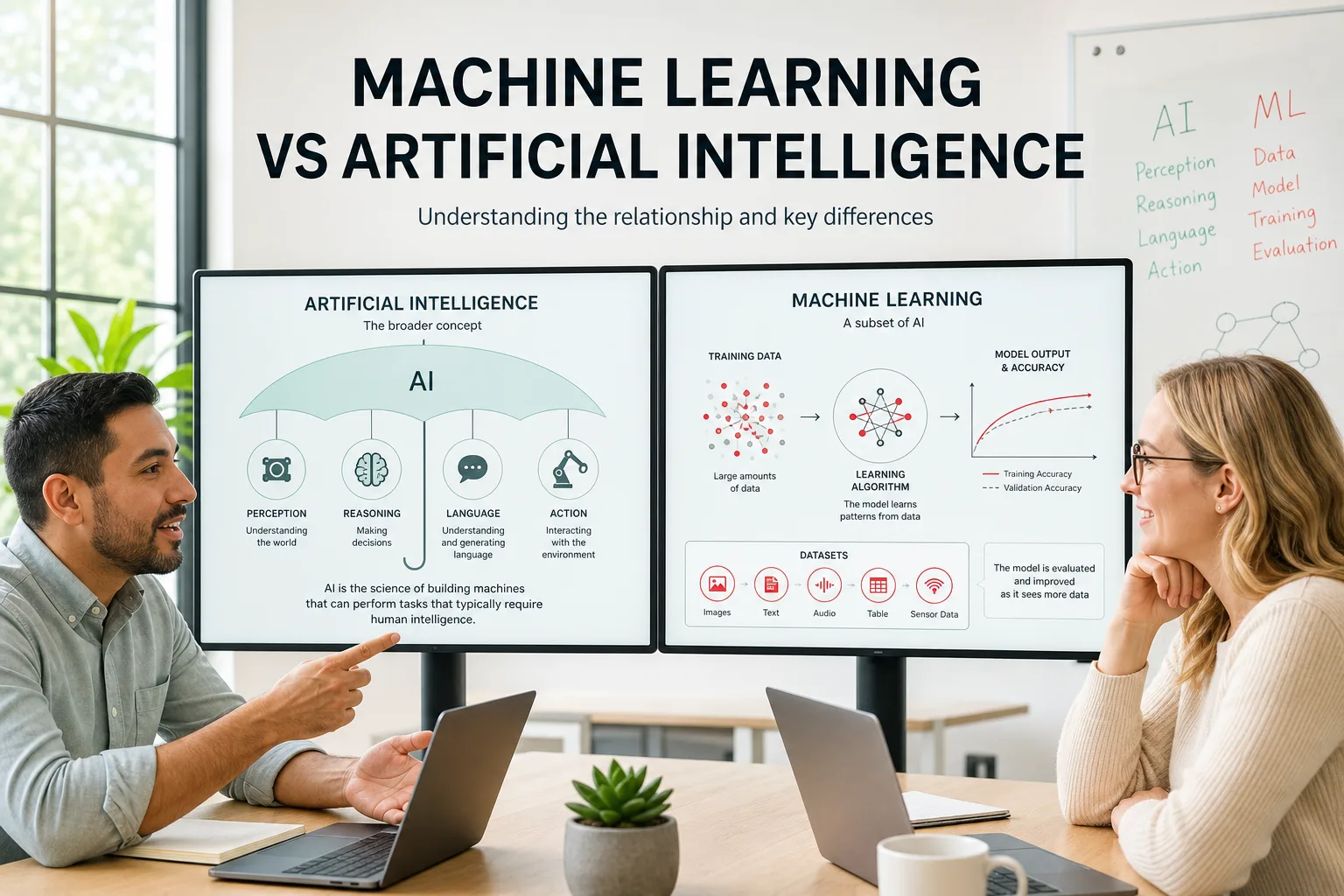
Artificial Intelligence (AI) has become one of the most talked-about technologies in business. At the same time, another term frequently appears in conversations about AI: Machine Learning (ML). Although these terms are often used interchangeably, they are not the same.
Understanding the difference between Artificial Intelligence and Machine Learning helps business leaders make informed technology decisions and identify the right solutions for their organizations.
In this guide, we'll explain how AI and Machine Learning differ, how they work together, their business applications, and how businesses can benefit from each.
What Is Artificial Intelligence?
Artificial Intelligence is the broader concept of creating computer systems capable of performing tasks that normally require human intelligence.
AI systems can:
- Understand language
- Analyze information
- Make recommendations
- Solve problems
- Generate content
- Recognize images
- Process speech
- Automate workflows
Artificial Intelligence includes many technologies, including Machine Learning, Natural Language Processing, Computer Vision, Robotics, and Generative AI.
Think of AI as the overall field that contains many specialized technologies.
For a broader look at how AI is reshaping operations, read how AI is transforming modern businesses.
What Is Machine Learning?
Machine Learning is a branch of Artificial Intelligence.
Instead of relying entirely on predefined rules, Machine Learning enables computers to learn from data and improve performance over time.
Machine Learning systems identify patterns and use those patterns to make predictions or decisions.
Examples include:
- Sales forecasting
- Product recommendations
- Fraud detection
- Customer segmentation
- Demand forecasting
- Spam detection
- Predictive maintenance
Machine Learning becomes more accurate as it learns from additional data.
Many of these predictive use cases overlap with Traditional AI applications that analyze data to automate decisions rather than generate new content.
AI vs Machine Learning at a Glance
| Feature | Artificial Intelligence | Machine Learning |
|---|---|---|
| Scope | Broad field | Subset of AI |
| Goal | Simulate human intelligence | Learn from data |
| Decision Making | Rules, reasoning, learning, and automation | Data-driven predictions |
| Data Requirement | Varies by application | Requires training data |
| Examples | Chatbots, AI agents, computer vision | Recommendation engines, fraud detection |
How Artificial Intelligence Works
AI combines multiple technologies to solve business problems.
Examples include:
- Natural Language Processing
- Computer Vision
- Machine Learning
- Speech Recognition
- Expert Systems
- Generative AI
Many modern AI applications combine several of these technologies within a single solution.
This layered approach is common when businesses build custom AI software that connects chatbots, analytics, automation, and internal business systems.
How Machine Learning Works
Machine Learning follows a structured process.
- Collect data.
- Prepare and clean the data.
- Train a Machine Learning model.
- Test the model.
- Deploy the model.
- Improve performance as more data becomes available.
Unlike traditional software, Machine Learning models improve through experience rather than manual programming.
Data preparation is one of the most important steps in any AI project. See how to build an AI-powered application for a practical overview of planning, data, and deployment.
Business Applications of Artificial Intelligence
AI supports many business functions.
Common examples include:
- AI chatbots
- Virtual assistants
- Intelligent document processing
- Content generation
- Workflow automation
- Customer support
- AI-powered search
- Business process automation
These applications help businesses improve productivity and customer experiences.
Explore AI chatbots for business and AI agents vs AI chatbots to understand how conversational and task-based AI differ in customer-facing and operational roles.
Business Applications of Machine Learning
Machine Learning focuses on recognizing patterns and making predictions.
Popular applications include:
- Sales forecasting
- Customer churn prediction
- Inventory optimization
- Product recommendations
- Predictive maintenance
- Financial risk analysis
- Marketing optimization
- Demand forecasting
Machine Learning helps organizations make data-driven decisions.
See top AI use cases across different industries for examples of how predictive and intelligent systems create value in healthcare, finance, retail, and other sectors.
Benefits of Artificial Intelligence
Businesses invest in AI because it can:
- Automate repetitive tasks
- Improve customer experiences
- Reduce operating costs
- Increase productivity
- Enhance decision-making
- Personalize services
- Improve operational efficiency
AI often combines multiple technologies to solve complex business problems.
Benefits of Machine Learning
Machine Learning provides value through intelligent analysis.
Benefits include:
- Better predictions
- Continuous improvement
- Faster analysis
- Higher accuracy
- Pattern recognition
- Data-driven recommendations
Organizations with large amounts of historical data often benefit significantly from Machine Learning.
When Should Businesses Use AI?
Artificial Intelligence is often the right choice when businesses need:
- Intelligent customer support
- AI chatbots
- Workflow automation
- Content generation
- Virtual assistants
- Smart search
- AI agents
These applications focus on improving user experiences and automating business processes.
AI automation for businesses is often the starting point when organizations want to connect AI to CRM, finance, HR, and operations workflows.
When Should Businesses Use Machine Learning?
Machine Learning is appropriate when businesses want to:
- Predict future outcomes
- Analyze customer behavior
- Detect fraud
- Forecast inventory
- Optimize pricing
- Improve marketing performance
- Analyze operational trends
Machine Learning delivers the greatest value when quality historical data is available.
Can AI and Machine Learning Work Together?
Absolutely.
Machine Learning is one of the core technologies powering many AI systems.
For example, an AI customer support assistant may use:
- Machine Learning to predict customer intent
- Natural Language Processing to understand questions
- Generative AI to create responses
- Workflow automation to complete business tasks
Modern AI applications often combine multiple technologies to deliver better results.
This combined approach is also how how AI improves customer service through smarter routing, faster responses, and more personalized support experiences.
Common Misconceptions
AI and Machine Learning Are the Same
Machine Learning is only one branch of Artificial Intelligence.
AI Always Learns Automatically
Not all AI systems use Machine Learning. Some follow predefined rules or use external knowledge sources.
Machine Learning Can Solve Every Business Problem
Machine Learning works best for prediction and pattern recognition. Other AI technologies may be better suited for language understanding, automation, or content generation.
How Kodu Media Helps Businesses Adopt AI
At Kodu Media, we help businesses identify the right AI technologies for their goals.
Our services include:
- AI consulting
- Machine Learning integration
- Custom AI software development
- AI chatbot development
- Workflow automation
- Predictive analytics
- API integration
- Mobile and web AI applications
- Business intelligence solutions
- Ongoing optimization
Every solution is designed to solve real business problems while supporting long-term growth.
Our AI development company team supports predictive analytics, intelligent automation, and custom AI applications. We also deliver AI automation services and AI chatbots and virtual assistants when AI needs to work across customer and internal workflows.
We integrate AI and Machine Learning into custom software development, mobile app development, and API development and integration projects when intelligent features must connect to existing business platforms.
Final Thoughts
Artificial Intelligence and Machine Learning are closely related, but they are not interchangeable.
Artificial Intelligence is the broader field focused on creating intelligent systems, while Machine Learning is one of the technologies that enables AI to learn from data and improve predictions.
Understanding these differences helps businesses choose the right technology for their objectives.
Whether you need customer support automation, predictive analytics, workflow optimization, or intelligent business software, selecting the right AI approach is essential for long-term success.
If you're exploring AI for your business, Kodu Media can help you evaluate your requirements, recommend the best technologies, and develop custom AI solutions that deliver measurable business value.
Contact us today to schedule a consultation and begin your AI transformation journey.
Frequently Asked Questions
Is Machine Learning the same as Artificial Intelligence?
No. Machine Learning is a subset of Artificial Intelligence that focuses on learning from data and making predictions.
Can AI exist without Machine Learning?
Yes. Some AI systems use predefined rules, knowledge bases, or other technologies instead of Machine Learning.
Which industries benefit most from Machine Learning?
Healthcare, finance, retail, manufacturing, logistics, marketing, and professional services all use Machine Learning for forecasting, recommendations, and predictive analytics.
Do I need large datasets for Machine Learning?
Many Machine Learning projects benefit from historical data, but the amount required depends on the problem being solved and the chosen approach.
Does Kodu Media develop Machine Learning solutions?
Yes. We design and develop custom Machine Learning models, AI-powered software, predictive analytics platforms, and intelligent business applications tailored to each client's goals.